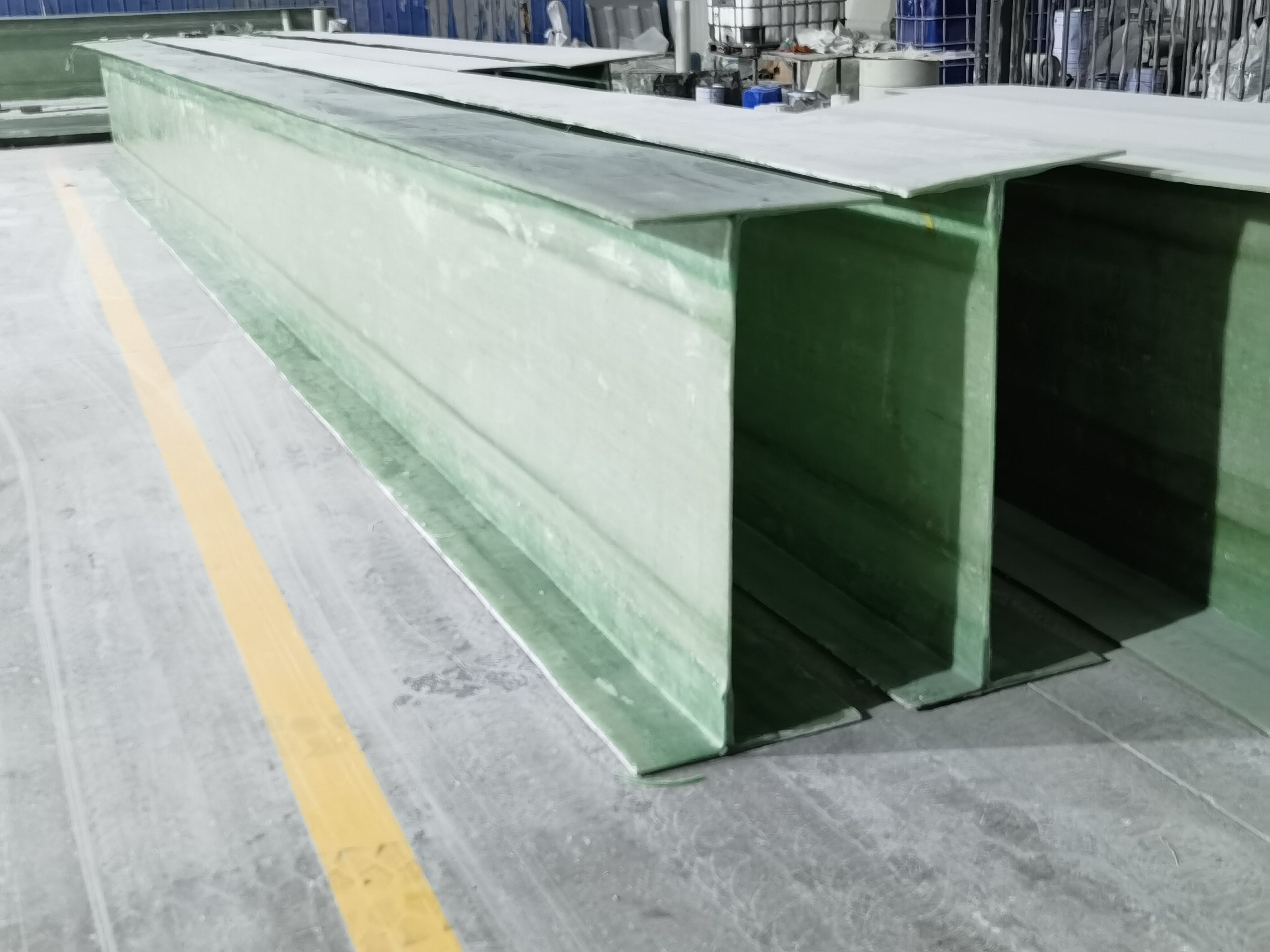
Fiberglass I-beam
Product Advantages
- 1Lightweight, high-strength structural profiles with large cross-sectional moment of inertia.
- 2Excellent flexural performance, ideal for structural building support
- 3Easy to install; significantly reduces structural self-weight.
- 4Superior corrosion resistance; no anti-corrosion treatment required.
- 5Non-magnetic insulation for specialized engineering applications
- 6Long service life with high overall economic benefits
Reference Price
$50-$120/meter
*Actual price varies based on specifications and quantity.
Use Cases
I. Product Overview
Fiberglass I-beams (FRP I-Beams) are advanced composite structural profiles manufactured via continuous pultrusion using high-performance fiberglass reinforcement and premium synthetic resins (such as unsaturated polyester, vinyl ester, or epoxy). As the ideal companion to GFRP rebar for subway shield tunneling, tunnel support, and rail transit construction, FRP I-beams perfectly replace traditional steel I-beams.
It inherits the core advantages of composite materials—lightweight, high strength, electrical insulation, non-magnetic properties, and exceptional corrosion resistance. With its superior cross-sectional efficiency, it provides critical support for lightweight and long-life upgrades in modern underground infrastructure. This solution has been successfully deployed in projects including Guangzhou Metro Line 8, Xiamen Metro, Wuxi Metro Line 3, and Nanning Rail Transit Line 1.
Key Application Scenario: Cuttable retaining structures at subway shield machine shafts
In subway shield tunneling projects, fiberglass I-beams are typically used in conjunction with GFRP rebars to form a cuttable retaining structure within the launch and reception shaft openings. Traditional approaches rely on reinforced concrete combined with steel I-beam joints, requiring manual chipping of portal concrete and cutting of rebar cages upon shield machine arrival—processes that pose high safety risks and may trigger water or sand inrush incidents. Replacing steel I-beam joints with fiberglass alternatives enables the shield machine to cut through directly without manual entry for demolition, fundamentally eliminating safety hazards at the source.
II. Core Performance and Outstanding Advantages
1. Lightweight yet high-strength, significantly reduces weight
- Density as low as 1.8–2.1 g/cm³, approximately 1/4 that of steel.
- Taking a 8-inch (203mm) FRP I-beam as an example, its unit weight is approximately 18–22 kg/m, whereas a hot-rolled H200×100 steel section of the same height weighs 50 kg/m.
- Vertical tensile strength reaches 300–500 MPa, with tensile and flexural strength comparable to standard carbon steel.
- Significantly reduces the overall self-weight of tunnel support and shield segment reinforcement structures, facilitating robotic arm grasping and installation by the shield machine.
2. Extreme corrosion resistance, maintenance-free for the entire lifespan
- Neither fiberglass nor the resin matrix undergoes chemical reactions with water, chlorides, acids, or bases.
- Resistant to rust and corrosion, eliminating the load-bearing capacity loss and structural safety risks associated with traditional steel structures.
- A case study from a chlor-alkali workshop shows that steel I-beams suffered severe corrosion after three years, while fiberglass I-beams maintained nearly unchanged cross-sectional dimensions after eight years.
- Extremely low total cost of ownership with a normal service life exceeding 50 years.
3. Cuttability ensures efficient shield tunneling.
- This is the core advantage of fiberglass I-beams in subway shield tunneling projects.
- Can be cut directly by the shield machine cutter head, eliminating the need for manual entry into the shaft to cut steel components.
- Prevents safety incidents such as mud and water inrush at the source.
- Reduces abnormal wear on the TBM cutterhead and extends equipment lifespan.
- Project timeline shortened by approximately 30%
4. Non-insulating and non-magnetic, ensuring precise shield tunneling guidance.
- As a non-conductive, non-magnetic material, it introduces no magnetic interference to the laser targets, gyroscopes, and other precision guidance systems of subway tunnel boring machines (TBMs).
- Ensures extremely high precision in tunnel excavation.
- Provides electromagnetic transparency for communication and signaling systems within tunnels, fully meeting subway tunnel electromagnetic shielding requirements.
5. Fatigue-resistant and waterproof
- Maintains structural integrity under long-term cyclic loading, with a fatigue life exceeding 200 million cycles.
- Completely impermeable to water—ideal for damp underground environments and areas with high water tables.
- The coefficient of thermal expansion closely matches that of concrete, resulting in minimal interfacial thermal stress and significantly reducing the risk of interface delamination during long-term service.
6. Easy to install, cost-effective and low-carbon
- Highly customizable, easy to cut, and precisely adjustable in length to meet engineering requirements.
- No welding required. Install quickly using dedicated connectors for high construction efficiency.
- Industry reports indicate that using high-performance fiberglass I-beams in construction projects can reduce overall costs by 15%–20%.
- Significant total cost of ownership advantage across the full lifecycle
III. Key Technical Specifications
| Parameter Item | Typical Value |
|---|---|
| Density | 1.8–2.1 g/cm³ (approximately 1/4 that of steel) |
| Longitudinal Tensile Strength | 300–500 MPa |
| Longitudinal Tensile Modulus | 23–30 GPa (approximately 1/7–1/10 of steel) |
| Flexural Strength | ≥250 MPa |
| Interlaminar Shear Strength | 20–35 MPa |
| Fiber Volume Fraction | 55%–72% |
| Operating Temperature Range | -50°C to 100°C |
| Barcol hardness | ≥35 |
| Thermal Conductivity | 1.25–1.67 kJ/(m·h·K), only 1/100–1/1000 of metal |
| Fire Resistance Rating (Subway-Specific) | Self-extinguishing, low smoke, non-toxic, and meets oxygen index standards. |
Important:Fiberglass I-beams are anisotropic materials. The pultrusion process aligns glass fibers highly along the longitudinal axis, resulting in significantly higher longitudinal strength compared to transverse strength (typically 10%–20% of the longitudinal value). Design selection must fully account for this characteristic.
IV. Core Application Scenarios in Metro and Rail Transit
FRP I-beams work in tandem with GFRP bars to form a "non-metallic composite structural system" for subway construction, primarily applied in the following critical scenarios:
1. Shield tunnel launch and reception shaft retaining structures
In subway shield tunnel construction at the terminal shafts, the shield machine must penetrate the retaining structure to enter and exit the tunnel. In traditional approaches, the tunnel portal uses reinforced concrete with steel I-beam connectors; since the shield cannot cut through these materials, workers must manually break the portal, cut the rebar, and sever the steel I-beams—a process posing extreme safety risks. By replacing steel rebars with glass fiber-reinforced polymer (GFRP) bars and steel I-beams with GFRP I-beams, the entire retaining structure becomes directly cuttable by the shield's cutter head.
Typical Cases:The Fengjiang Vent Shaft Project for Guangzhou Metro Line 8 adopted this technical solution: the retaining structure consists of underground continuous walls with internal supports. A total of 28 wall panels were designed, among which 4 panels within the shield tunnel section were specified as fiberglass-reinforced concrete walls with H-beam joints. Each standard panel has a width of 6 meters, a thickness of 0.8 meters, and a slurry trench depth ranging from 21.841 to 39.801 meters.
2. H-beam joint for diaphragm wall
In fiberglass-reinforced diaphragm walls, fiberglass I-beams are used as joint profiles, seamlessly connected to steel I-beams to form an "I-shaped GFRP–steel I-beam" joint structure. The flanges of the two spliced I-beams are linked by crossing GFRP bars to create a GFRP cage, ensuring the integrity of the retaining structure while enabling unobstructed excavation by the tunnel boring machine.
3. Tunnel and Station Structure Support
In subway station box structures, cross-passages, and emergency exits, FRP I-beams serve as temporary or permanent support beams and load-bearing frames, effectively resisting groundwater pressure and chemical erosion from surrounding strata. Used for initial tunnel lining steel arches, temporary supports, and rock mass reinforcement, they can fully replace traditional steel I-beam arches.
4. Rail and Cable Tray Systems
As the primary load-bearing beam for cable supports, walkway platforms, and drainage systems in subway tunnels, FRP I-beams ensure electrical safety through their insulating and flame-retardant properties, while their maintenance-free design significantly reduces long-term operational and maintenance costs.
5. Real-world procurement case study
In the underground continuous wall project for Suzhou East Station on the new Nantong-Ningbo High-Speed Railway by China Railway No. 14 Bureau, glass fiber I-beams and matching connectors were procured with specifications of 1.06×0.35×14.7m (thickness 12mm) and 1.06×0.35×20.2m (thickness 12mm).
6. Comprehensive Benefits
- Security Enhancement:Eliminates the need for manual tunnel excavation and cutting, fundamentally preventing safety incidents such as collapses and water inflows.
- Reduced Lead Time:Eliminates the manual breaking step, shortening the schedule by approximately 30%.
- Device Protection:Reduce abnormal wear on the TBM cutterhead and extend equipment service life
- Cost Optimization:Total cost of ownership reduced by 15%–20% compared to traditional solutions.
- Same Material Source:Achieve long-term service of the support system for over 50 years, perfectly synchronized with the mechanical degradation and durability performance of GFRP rebars.
V. Production Process and Customization Capabilities
Premium FRP I-beams are manufactured using a continuous pultrusion process, where glass fibers are precisely pulled through a resin bath and cured in a heated mold. This ensures consistent cross-sectional dimensions and high fiber volume content (typically 65%–80%).
To meet the unique requirements of metro projects, source manufacturers typically possess strong customization capabilities:
- Customize special-shaped I-beams with varying cross-sections, thicknesses, and mechanical properties by rapidly creating molds based on tunnel design drawings.
- Supports custom-length cutting, punching, and splicing without altering existing tunnel support construction processes.
- Seamlessly tied and anchored with GFRP rebars and GFRP anchors.
- End-to-end services from design detailing and fabrication to installation guidance.
6. Industry Standards
| Standard Number | Standard Name |
|---|---|
| GB/T 31539-2015 | Pultruded Profiles of Fiber-Reinforced Composites for Structural Applications |
| JG/T 406-2013 | Fiber-Reinforced Polymer Bars for Civil Engineering Applications |
| MT/T 1061-2008 | Mine-Grade Glass Fiber Reinforced Plastic Anchor |
| EN 13706 | "European Standard for Pultruded Fiberglass Reinforced Plastic Profiles" |
| ASTM E2755 | Standard for Testing Bending Load Capacity of I-Beams Made with FRP |
| T/CCTAS 46-2022 | Technical Specification for Strengthening Rail Transit Tunnels with Prefabricated Composite Profiles |
VII. Selection and Construction Precautions
1. Mechanical Performance Limits
The elastic modulus of fiberglass I-beams is approximately 1/7–1/10 that of steel. Under identical cross-sections and loads, their deflection far exceeds that of steel beams. In design, deflection typically governs rather than strength; therefore, section sizes must be selected appropriately based on project requirements. Additionally, FRP materials exhibit no yield plateau; they remain linearly elastic until reaching ultimate strength, followed by sudden brittle failure. A safety factor of 3.0–4.0 should be applied. During the structural design phase, it is recommended to perform a holistic structural analysis integrating FRP I-beams with GFRP rebar to fully leverage the mechanical advantages of the composite material's anisotropy.
2. Anisotropy
Pultrusion aligns fibers highly along the axial direction, yielding high longitudinal strength but low transverse and interlaminar strength. Connection node design requires special attention—bolt holes in webs can initiate interlaminar shear failure.
3. Construction Specifications
- Field cutting must use diamond blades; welding is strictly prohibited.
- Fasten and connect using dedicated non-metallic connectors or structural adhesives.
- Use soft slings during lifting to prevent hard damage to the profile edges from wire ropes.
- Store in a dry, shaded area to prevent resin matrix degradation.
4. Quality Screening
When procuring, require manufacturers to provide third-party reports on mechanical properties and flame retardancy/insulation. Focus on key metrics such as tensile strength, flexural strength, fiber volume fraction, and Barcol hardness. Prioritize suppliers with proven track records in metro projects and relevant industry certifications. Source directly from manufacturers with independent mold workshops and robust quality control systems.
8. Why Choose Anhui Send New Materials for Subway GFRP Support Projects
Current rail transit projects, such as subway tunnels and underground utility corridors, have fully entered an era of all-composite support systems characterized by corrosion resistance, durability, electrical insulation, non-magnetism, and long-term maintenance-free operation. Anhui SenDe New Materials Technology Development Co., Ltd. was established in 2017 6 and is located at No. 19, Jingwu Road, Quanjiao County Economic Development Zone, Chuzhou City, Anhui Province. We are a leading manufacturer of GFRP profiles specifically designed for subway applications.
(1) Customized Special Conditions: Developed specifically for subway tunnels, fully compatible with the complete GFRP support system.
Most FRP profiles on the market adhere to general industrial standards and cannot meet the unique requirements of subway operations. All fiberglass I-beams from Anhui Sende are specifically engineered for subway tunnel conditions, directly addressing industry-specific adaptation challenges:
- Material-matched sourcing, support-aligned service life:Sund GFRP I-beams, paired with matching GFRP rebars and GFRP anchors, utilize a unified system of virgin E-glass fibers and corrosion-resistant vinyl ester resin. This ensures consistent mechanical degradation rates, superior corrosion resistance, and matched thermal expansion coefficients, delivering long-term durability for tunnel support structures exceeding 50 years.
- Metro-grade non-magnetic insulation ensures operational safety.The product contains no metal materials or metal impurities. Its insulation and non-magnetic properties fully meet specifications, completely eliminating issues related to electromagnetic induction and signal interference.
- Fire-retardant formula specifically designed for subways: worry-free fire safety inspections.Features a custom flame-retardant modified compound that self-extinguishes when exposed to fire, emits low smoke and is non-toxic, prevents open-flame spread, meets oxygen index standards, and perfectly complies with fire safety requirements for subway underground enclosed spaces.
(2) Source Factory Quality Control: Eliminate common small-factory issues for stable performance and engineering calculation compliance.
As a direct manufacturer, Anhui Send features its own fully automated pultrusion production line, adhering to the highest standards for subway engineering materials:
- Scalable production capacity and supply assurance:The company operates over 30 fiberglass rebar production lines, 18 fiberglass anchor rod production lines, and more than 10 fiberglass profile production lines, with an annual capacity of 35,000 tons—meeting the dual requirements of delivery timelines and product quality for large-scale projects such as subway systems.
- Real, precise ingredient ratios:Strictly uses high-purity, alkali-free fiberglass roving and corrosion-resistant vinyl ester resin. No recycled materials or inferior fillers are used, ensuring dense profiles with no delamination or voids.
- Consistent batch quality:Fully automated, integrated molding process eliminates manual production errors, ensuring highly consistent mechanical properties, dimensional tolerances, and durability across every batch.
- Complete compliance documentation:Each batch includes a certificate of conformity, performance test report, and subway-specific flame-retardant certification. Supports third-party sampling re-inspection by CMA/CNAS-accredited laboratories. Fully documented and fully compliant.
(3) Construction-ready: Optimized for subway tunnel projects to reduce costs and boost efficiency.
- Lightweight and easy to handle: reduces construction time.Product weight is only 1/4 of traditional steel I-beams. No heavy lifting equipment is needed; manual handling, positioning, and installation are sufficient.
- Customized processing tailored to on-site manufacturing processes:Supports custom cutting, punching, splicing, and shaping to fully replace traditional I-beams without modifying existing tunnel support construction processes.
- Zero post-launch maintenance costs:Resistant to groundwater, saline-alkali soil, and moisture corrosion. Never rusts; no annual rust removal or anti-corrosion painting required.
(4) One-Stop Support Services: Hassle-free, efficient delivery for large-scale metro projects
- One-stop supply for all product lines:Fully compatible accessories available, including GFRP bars, GFRP anchors, anchoring sleeves, and specialized clamps, with precise dimensional matching.
- Metro-Specific Technical Empowerment:Backed by a professional technical team, we offer specialized services including specification selection, structural load analysis, guidance on integrating new and old construction methods, and on-site technical briefings.
- Stable Delivery and Quality Assurance:Owns large-scale production lines with ample capacity to meet bulk and phased supply needs for major metro projects, backed by a comprehensive after-sales warranty system.
Summary:Glass fiber I-beams offer a comprehensive set of advantages, including lightweight yet high strength, machinability, corrosion resistance, and electromagnetic insulation. When paired with glass fiber reinforced polymer (GFRP) rebars, they form an ideal solution for cuttable retaining structures at shield tunnel access shafts in metro projects and for full-composite support systems throughout the tunnel. Anhui Sende New Material Technology Development Co., Ltd.'s glass fiber I-beams are purpose-built to meet the demanding conditions of metro construction. As a product developed within the same GFRP ecosystem, it ensures performance compatibility and regulatory compliance. It is the reliable first choice for replacing traditional steel beams in GFRP rebar-supported applications.