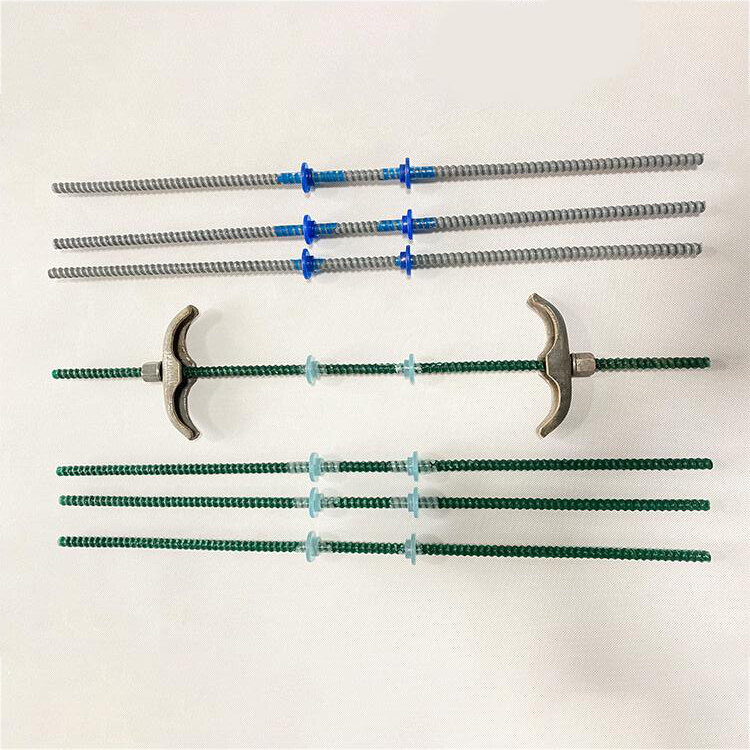
Fiberglass Waterstop Bolt
Product Advantages
- 1Rust-proof: Eliminates rust leaks at the source, keeping walls clean and repair-free.
- 2Lightweight design: Weighs only 1/4 of a steel bolt, making handling and installation easier.
- 3Reusable Collapsible Frame: Three-stage design enables over 10 reuse cycles, reducing total cost of ownership.
- 4Integrated Waterstop: Injection-molded (no glue), won't separate during pouring, reliable waterproofing.
- 5Cut-free demolding: Pull out the entire bar; walls remain rust-free and ready for the next step.
- 6Corrosion-resistant with long service life: no significant degradation in acidic, alkaline, or salt spray environments for over 10 years
Reference Price
¥2.5-4/unit
*Actual price varies based on specifications and quantity.
Use Cases
I. Product Definition
Fiberglass waterstop bolt, formally known as fiberglass-reinforced polymer (FRP) waterstop tie rod (GFRP Waterstop Bolt), is a high-strength rod manufactured via continuous pultrusion using E-glass fibers as reinforcement and acid-alkali-resistant resin (vinyl ester/epoxy/polyester) as the matrix. It is part of an integrated formwork support and waterproofing system that includes a one-piece waterstop plate, specialized nuts, and washers.
Design Intent:Leverage the natural corrosion resistance of composite materials to replace traditional steel waterstop screws at the source, solving the industry's three major pain points in one go: rust-induced leakage, formwork removal repairs, and post-construction cutting.
This series covers three types.
| Type | Structural Features | Core Use Cases |
|---|---|---|
| Fiberglass tie rod | Full-threaded rod body, no water stopper. | Formwork reinforcement for beams, columns, and walls of above-ground structures |
| Fiberglass Through-wall Bolt | Full-threaded rod with nuts and washers at both ends | Wall reinforcement in non-waterproof areas above the floor |
| Fiberglass Waterstop Bolt | Mid-section of the rod body with an integrated waterstop | Waterproofing for basement exterior walls, water tanks, and utility tunnels |
Waterproof bolts come in two types.
Three-Stage
Center stop rod + two reusable outer rods; outer rods can be recycled 10+ times
All-in-One
Equipped with a waterstop strip for single-use application; the top choice for projects with high waterproofing requirements.
2. GFRP vs. Steel Water-Stop Screws: Key Differences
| Comparison Criteria | Steel Waterstop Bolt (Traditional) | GFRP Waterstop Bolt |
|---|---|---|
| Material | Q235/Q345 Carbon Steel | E-glass fiber + resin matrix |
| Sealing method | Weld steel waterstop (full penetration weld) | Integrated Injection-Molded Waterstop (Non-Welded) |
| Corrosion resistance | Poor. Yellow water seeps from the wall after rusting. | Extremely durable, rust-free from the source. |
| Weight | Weight (Φ14 approx. 1.2kg/m) | Light (Φ14 approx. 0.3kg/m, only 1/4) |
| Formwork Stripping | Excludes gas cutting + Rust repair | Pull out the entire rod; no rust on the wall, no repairs needed. |
| Stiffness | High (E≈200GPa) | Low (E≈4 GPa, approximately 1/5 of steel) |
| Failure Mode | Ductile with early warning | Brittle, sudden fracture without warning |
| Unit Price | Base Price (Φ14, approx. 0.8~1.2 CNY/piece) | Approximately 2 to 3 times that of a steel screw (Φ14 is approximately 2.5 to 4 yuan per piece). |
| Electromagnetic Properties | Conductive and magnetic | Insulated, non-magnetic |
| Thermal bridging effect | Clearly, prone to condensation | Tiny, energy-efficient |
One sentence: GFRP waterstop bolts don't sell "stronger"; they deliver rust-free, clean walls, and recyclability.
III. Core Performance Specifications
1. Common Specifications & Technical Parameters
| Nominal Diameter (mm) | Tensile Strength (MPa) | Ultimate Tensile Strength (kN) | Elastic Modulus (GPa) | Weight per unit (kg/m) | Applicable Wall Thickness (mm) |
|---|---|---|---|---|---|
| 12 | ≥600 | 68 | ≥40 | 0.18 | 100~200 |
| 14 | ≥600 | 92 | ≥40 | 0.24 | 150~250 |
| 16 | ≥600 | 121 | ≥40 | 0.32 | 200~300 |
| 18 | ≥600 | 153 | ≥40 | 0.40 | 250~350 |
| 20 | ≥600 | 188 | ≥40 | 0.50 | 300~400 |
The dimensions of the waterstop strip are typically 80×80mm or 100×100mm; length can be customized per project.
2. Material Composition
| Components | Material | Share/Function |
|---|---|---|
| Reinforcement Material | E-glass fiberglass | Bear the full tensile load; accounts for 65%~75% of total mass. |
| Matrix material | Vinyl Ester Resin (Preferred) / Epoxy Resin / Polyester Resin | Encapsulate fibers, transfer shear forces, and isolate against erosion. |
| Waterstop | Nylon 66 / Modified PP | Harder than concrete; pours without cracking. |
| Functional Additives | Antistatic agents, flame retardants, UV absorbers, etc. | Meets special requirements for coal mines, such as flame retardancy and antistatic properties. |
Procurement Key: The resin system determines alkali resistance and durability. Prioritize vinyl ester resins (alkali resistance ranking: vinyl ester > epoxy > polyester).
4. Eight Core Focus Areas (Essential for Engineers and Buyers)
Mechanical Properties
1. Can it withstand concrete lateral pressure? Will it burst?
Tensile strength ≥500MPa is sufficient for standard wall thicknesses (≤500mm). However, with a modulus of elasticity of only 40GPa, deflection reaches 3~5 times that of steel rods. For walls thicker than 600mm, reduce the screw spacing or increase the diameter.
2. Is the hollow wall thickness sufficient? Will it collapse during pouring?
Wall thickness is typically ≥2.5mm (for Φ14 size) and will not collapse under normal lateral pressure (≤60kN/m²). However, GFRP fails by brittle crushing rather than bending like steel screws, so overloading during concrete pouring is strictly prohibited.
3. Will the waterstop be crushed by the concrete?
✅ No. Nylon 66 and modified PP are harder than concrete. However, the waterstop must be centered during installation; eccentricity can cause localized stress concentration.
4. Is the connection between the screw rod and the water stop plate secure?
This is the most critical manufacturing detail. One-piece injection-molded joints offer pull-out strength ≥5kN, far exceeding actual load requirements. In contrast, inferior products use adhesive bonding, which can fail under pouring vibration—avoid these during procurement.
5. Can it be used as a load-bearing reinforcement?
❌ Absolutely not. Its modulus of elasticity is only 1/5 that of steel reinforcement. Using it as a primary load-bearing bar would cause excessive wall deflection and cracking. It should only be used for tie rods, never to replace structural reinforcement.
Waterproof Performance (The #1 Reason to Buy)
6. Does it really not leak? What makes it better than steel bolts?
Steel bolt water leakage path: Bolt body rusts → Rusty water penetrates along the bolt → Yellow rust stains on the wall. GFRP never rusts, cutting off this path at the source. Measured wall water seepage rate is reduced by more than 80% compared to steel bolts.
7. Is the waterstop width sufficient? What does the specification require?
Standard: 40~60 mm. Per GB 50164, the waterstop width must be at least 1/2 of the wall thickness and ≥ 50 mm. When purchasing, confirm it is ≥ 50 mm; do not buy narrower ones.
8. Will there be marks on the wall after formwork removal?
✅ Key Benefits: Steel bolts leave two rusted holes after removal, requiring waterproof mortar repair. GFRP rods can be fully extracted, leaving only two clean small holes on the wall—no repair needed, allowing immediate progression to the next phase. Saves labor and materials; shortens construction schedule by 1~2 days per floor.
9. Can it be recycled or reused?
✅ Yes. The three-section outer rod is retractable with a recovery rate of ≥90%. Steel rods suffer severe deformation after formwork removal and are typically scrapped. Based on 100 cycles, the per-use cost of GFRP can be lower than that of steel rods.
5. Construction Precautions (Most Problem-Prone On-Site Areas)
10. How do I secure it? Is it the same as the steel threaded rod using a U-bolt clamp and nut?
External fixing method is the same: U-clamp + nut + steel plate. However, you must use a dedicated GFRP nut or nylon nut; do not directly screw in a steel nut. Steel nuts are too hard and can crush the GFRP threads.
11. Can it be welded in place?
❌ Absolutely not. GFRP decomposes at high temperatures and releases toxic gases. All connections must be mechanical.
12. How do I cut it? Can I use a rebar cutter?
❌ Do not use a rebar cutter (it will crush the pipe wall). Use a diamond blade or resin abrasive wheel for cold cutting instead.
How to extend a two-section screw?
Use a dedicated coupling sleeve (internal + external threads) with a socket length ≥ 50 mm, then secure with nuts. The joint strength is approximately 80% to 90% of the rod body. Tying with wire is strictly prohibited.
14. Will the vibrating rod displace the screw during pouring?
GFRP weighs only 1/4 of steel, making it more prone to vibration-induced misalignment. Solutions: ① Widen the waterstop to 60 mm to increase damping; ② Reduce screw spacing by 20% compared to steel screws; ③ Avoid direct placement of vibrators over the screws during compaction.
15. Will it become brittle in winter construction?
GFRP exhibits superior low-temperature performance compared to steel (no cold brittlement), but the resin matrix may become slightly brittle below -20°C. For winter conditions in northern regions, products with vinyl ester resin matrices are recommended.
6. Durability and Environmental Adaptability
16. Will prolonged submersion of basement exterior walls lead to performance degradation?
No. It retains ≥90% of its strength after 10 years of submersion in water. This is the core application scenario where it replaces steel bolts.
17. Is it suitable for chemical corrosion environments (acid/alkali tanks, seawater)?
✅ Exceptional corrosion resistance. In seawater, acid/base pools, and industrial wastewater tanks, steel bolts corrode through in six months, while GFRP bolts remain virtually unchanged for 10+ years.
18. Does UV exposure cause aging?
Yes, but the water-stop bolt is embedded in concrete and not exposed to UV radiation. It performs far better than externally used GFRP anchors.
19. How long does it last?
Designed for a service life of 50 years, matching that of concrete. Resistant to corrosion and creep; theoretically, as long as the concrete remains intact, the threaded rod will not fail.
7. The Math: Why It's Expensive—and Still Sells
| Comparison Items | steel screw | GFRP Screw |
|---|---|---|
| Unit Price of Material | Φ14 approx. 0.8~1.2 CNY/piece | Φ14 approx. 2.5~4 CNY/piece |
| Wall Repair Fee | Approximately 3–5 per hole | 0 |
| Formwork removal and cutting fees | Oxy-fuel cutting + manual labor, approx. 2~3 CNY per hole | No cutting required, 0 |
| Schedule Impact | Repair delays 1~2 days/layer | No patching needed, save 1–2 days per layer |
| Trade-in and Recycle | Basic Scrapped | The outer rod can be recycled 100 or more times. |
Total Cost Analysis: The price difference is recovered at basement levels 3 to 5. The higher the floor, the greater the savings. Lifecycle costs are 30%–40% lower than steel screw anchors.
8. Application Scenario Matching
| Scenario | Recommend | Reason |
|---|---|---|
| Underground exterior walls, water tanks, and dams | ✅ Highly Recommended | Long-term water exposure will inevitably rust steel bolts. GFRP is the optimal solution. |
| Sewage treatment plant, chemical pools | ✅ Highly Recommended | Steel bolts fail within six months in acidic and alkaline corrosive environments. |
| Coastal structures, offshore engineering | ✅ Recommended | Chloride corrosion resistance: GFRP is immune. |
| Subway Station, Underground Utility Tunnel | ✅ Recommended | Moisture-resistant: no repairs needed, saves time |
| Livestock farming (pig farms, cattle ranches) | ✅ Recommended | Wastewater is highly corrosive. Steel screws corrode within 1 to 2 years, while GFRP does not have this issue. |
| Standard residential basement (floors 1–2) | ⚠️ Check Budget | Rust issues are not severe, so steel screws remain viable. GFRP represents a quality upgrade. |
| High-rise building core (wall thickness > 600 mm) | ⚠️ Use with Caution | High lateral pressure and excessive GFRP deflection require denser screw spacing, diluting the cost advantage. |
| Tight-deadline projects | ❌ Not Recommended | Higher construction precision required; workers need an adjustment period. |
Decision in a sentence: No rust, no repairs? ✅ GFRP is built for you. Long-term immersion or acid/alkali exposure? ✅ GFRP replaces steel anchors as the sacrificial component. Tight budget and basement has only 1 level(s)? ❌ Steel anchors are sufficient. Need recyclability and reuse? ✅ GFRP; after 100 cycles, cost per use drops below steel.
9. Mandatory Procurement Checklist
| Required | Qualification Criteria | Why it matters |
|---|---|---|
| Connection method between waterstop and rod body | One-piece injection molded (no adhesive) | Adhesive casting may detach; reject immediately. |
| Alkali-resistant immersion strength retention rate | ≥75% (GB/T 34551) | Core Metrics for Assessing Long-Term Durability |
| Full-length anti-compression system test | Mandatory: not just testing rod tensile strength. | System performance is what engineering needs. |
| Nut Material | GFRP nut or nylon nut | Steel nuts can crush GFRP threads. |
| Waterstop Width | ≥50mm, material: Nylon 66/Modified PP | <50mm Non-compliant |
| Recycle Count and Post-Recycle Strength | Specify the number of recyclable cycles and the retained strength rate. | Key to calculating total cost of ownership |
The one question you must ask during procurement: "Is the waterstop and rod body integrally molded or bonded? Bonded ones are immediately rejected."
10. Relevant Standards
| Standard Number | Name | Applicable Scope |
|---|---|---|
| JG/T 406-2013 | Fiber-reinforced polymer rebars for civil engineering | Core General Standards for Product Inspection |
| GB 50164 | Standard for Quality Control of Concrete | Waterstop width and other waterstop requirements |
| GB 50108-2008 | Technical Code for Waterproofing of Underground Engineering | Basis for Waterproofing Engineering Design |
| MT/T 1061-2008 | Resin bolt fiberglass reinforced plastic rod | Dedicated for the Coal Mining Industry |
| MT/T 146-2025 | resin anchor | Implemented in 2025 12, latest version |
| GB 50608-2010 | Technical Specification for Application of Fiber-Reinforced Composite Materials in Construction Projects | Primary Basis for Design and Application |
| T/CWEC 47-2024 | Technical Specification for Support Engineering Using Fiber Glass Anchor Rods | Implemented in 2024 8 |
| DB32/T 4783-2024 | Jiangsu Foundation Pit Engineering (Local Standard) | Regional Reference |
No unified national product standard exists for GFRP waterstops. When purchasing, require manufacturers to provide enterprise test reports (MA/CNAS certified).
11. About Anhui Send New Materials
Anhui Send New Material Technology Development Co., Ltd. was established in 2017, located in Quanjiu County, Chuzhou City, Anhui Province. With a registered capital of 2000 ten thousand yuan, it is a national high-tech enterprise and operates an independent industrial base covering 37,535 square meters.
Product Line
Fiberglass waterstop tie rods, fiberglass tie bolts, fiberglass wall-penetrating bolts, fiberglass hollow anchor bars, fiberglass rebars, and more.
Core Specifications of Waterstop Bolt (Φ14 Size)
| Parameters | Value |
|---|---|
| Tensile Strength | ≥600 MPa |
| Elastic Modulus | ≥40 GPa |
| Unit Weight | 0.24 kg/m |
| Waterstop Width | ≥50mm (Nylon 66/Modified PP) |
| Nut | Dedicated GFRP Nut |
Qualifications and Performance
- ISO9001 Quality Management System Certification
- Manufactured strictly in accordance with JG/T 406-2013 standards
- Holds patents; established industry-academia-research collaboration with Jilin University
- Continuously awarded major projects: Zhongtian Hechuang Mengkeqing Coal Mine (2023 years, 94.6 million CNY, sole winner), Yushuwan Coal Mine (2024 years), Shaanxi Yulin Energy Group (2025 years), Shendong Coal ( 2026 years, top candidate, 309 million CNY)
- Aquaculture Industry Clients: Muyuan Shares, Twin Brothers Group, New Hope Group
Four Key Benefits
Premium materialVinyl ester resin + AR-glass: Alkali resistance backed by data.
Industry-leading craftsmanshipFully automatic pultrusion line: uniform wall thickness and precise dimensions
One-piece injection-molded waterstopNon-adhesive; does not separate during casting
One-stop service— From selection guidance and mechanical testing to after-sales support
12. Industry Outlook
GFRP waterproofing bolts are evolving from an alternative solution to the industry standard for high-quality underground waterproofing. With the expansion of underground construction, stricter environmental regulations, and rising demands for construction efficiency, GFRP bolts with lower total lifecycle costs will continue to capture a larger market share.
If you're selecting materials for basement or pool projects, share the wall thickness, water level height, and corrosion environment grade. I'll calculate whether GFRP is cost-effective for you.