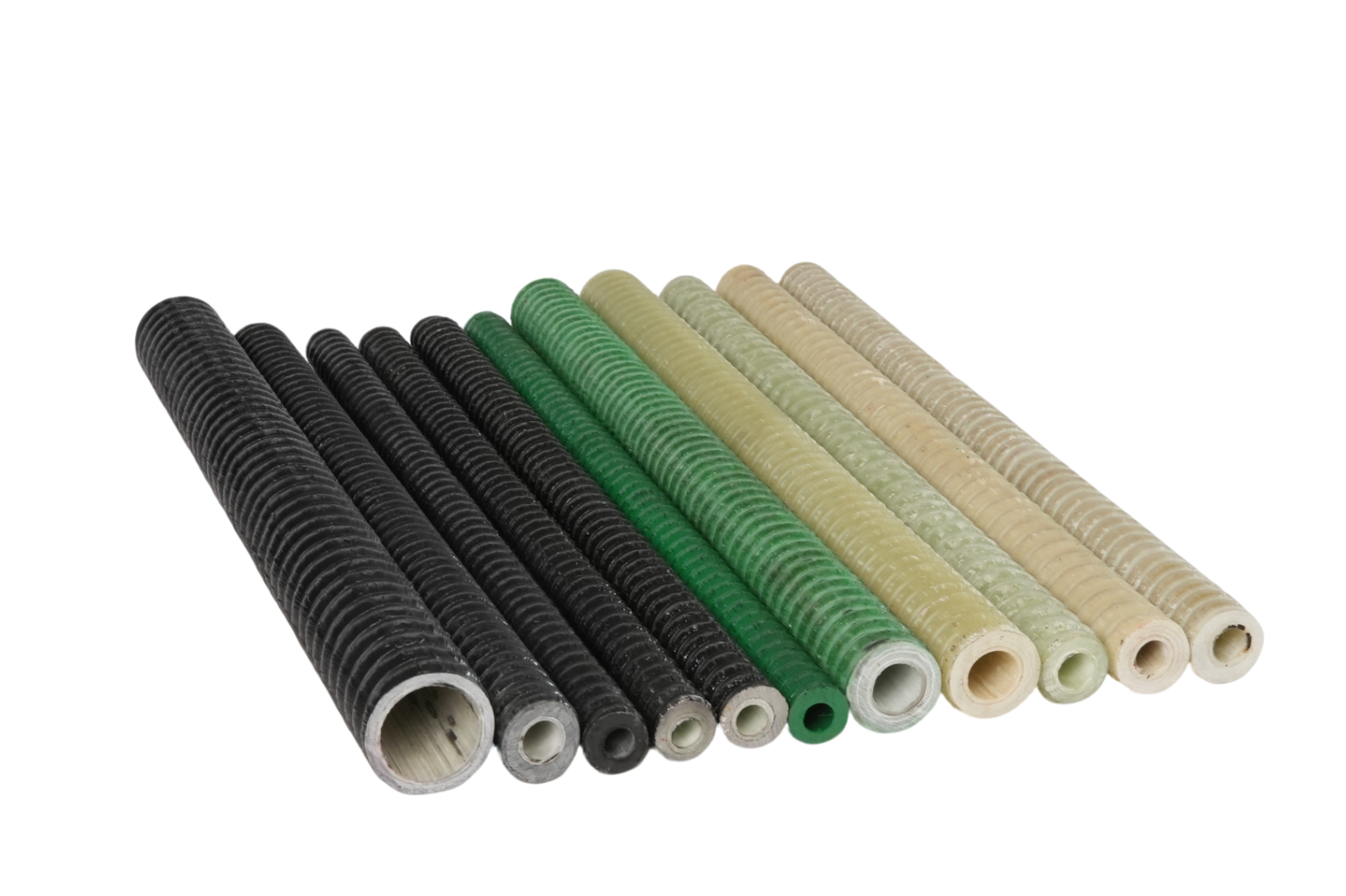
Fiberglass Hollow Anchor Bar
Product Advantages
- 13-in-1 integrated function: Combines drilling, anchoring, and grouting. Its unique hollow structure (inner diameter Φ10-20 mm) enables full-length grouting reinforcement.
- 2Uniform reinforcement: Grout is evenly injected into surrounding rock and soil through hollow channels, effectively improving overall stability and load-bearing capacity of the surrounding rock. Grouting coverage increases by more than 60%.
- 3High Pressure Resistance: Tensile strength ≥ 550MPa, withstands grouting pressures of 0.5-2.0 MPa without deformation or rupture; maximum pressure capacity up to 3.0MPa.
- 4Ideal for Complex Geology: Specifically designed for support engineering in challenging conditions such as weak and fractured rock masses, fault zones, and water-rich strata.
- 5Excellent sealing performance: Equipped with dedicated grouting fittings and stop plugs at the ends to ensure tight, leak-free grouting.
- 6Efficient and convenient construction: Easy, fast installation with no additional grouting pipes required. Boosts construction efficiency by over 50%, making it the ideal choice for tunnel engineering and underground space development.
Reference Price
¥12-28/piece
*Actual price varies based on specifications and quantity.
Use Cases
Comprehensive Technical & Procurement Guide for GFRP Hollow Anchor Bolts
I. Product Definition
Fiberglass hollow bolt, fully named Glass Fiber Reinforced Polymer Hollow Grouting Bolt (GFRP hollow bolt), is a fully threaded hollow composite anchor made from high-strength fiberglass as the reinforcement and thermosetting resin as the matrix, manufactured through pultrusion, high-temperature curing, and other processes.
Unlike solid GFRP anchors, its defining feature is a continuous hollow bore along the entire rod length (grouting channel), enabling integrated drilling, grouting, and anchoring. This makes it especially suitable for complex geological conditions such as fractured rock, weak rock, and high-stress zones with large deformations.
The product consists of a carbide drill bit, hollow fully threaded anchor rod body, grout stopper, washer, nut, and coupling sleeve. It is available in two types: self-drilling (self-advancing) and insert-then-grouting.
II. Raw Materials and Manufacturing Process
1. Core Ingredients
| Components | Material | Function |
|---|---|---|
| Reinforcement Material | E-CR E-glass fiber (alkali content < 1%, compliant with GB/T 18369) | Bears the full tensile load, defining the anchor's strength limit. |
| Matrix material | Vinyl Ester Resin / Epoxy Resin / Unsaturated Polyester Resin | Encapsulates fibers, transfers shear forces, and isolates from external corrosion. |
| Functional Additives | Antistatic agents, flame retardants, curing agents, UV absorbers, etc. | Meets special operating requirements such as flame retardancy and antistatic properties in coal mines. |
Key Procurement Insight: The resin system determines alkali resistance and durability. Prioritize vinyl ester resins (alkali resistance ranking: vinyl ester > epoxy > polyester).
2. Production Process
Adopt continuous pultrusion as the primary manufacturing process:
Unwind fiberglass roving → Resin impregnation → Mandrel preforming → High-temperature curing and crosslinking in mold → Pull-through → Thread machining → Cut to length → Final inspection
Large-diameter, high-pressure-rated models feature an alternating multi-layer structure of axial and hoop fiber yarns, with burst pressure ratings up to ≥8 MPa and inner diameters exceeding 30 mm. They support high-pressure, rapid, large-volume grouting.
III. Core Performance Specifications
1. Common Specifications & Technical Parameters
| Model | Diameter (mm) | Inner Diameter (mm) | Tensile Strength (MPa) | Tensile Force (kN) | Shear Strength (MPa) | Elastic Modulus (GPa) | Theoretical Weight (g/m) |
|---|---|---|---|---|---|---|---|
| MGK-25 | 25 | 12 | ≥600 | ≥180 | ≥110 | ≥40 | 950 |
| MGK-28 | 28 | 14 | ≥600 | ≥200 | ≥110 | ≥40 | 1,200 |
| MGK-32 | 32 | 16 | ≥600 | ≥290 | ≥110 | ≥40 | 1,500 |
| MGK-38 | 38 | 20 | ≥600 | ≥440 | ≥110 | ≥40 | 1,750 |
Customizable length, typically 1m–8m; wall thickness ≥3mm with a safety factor of at least 2.5x.
2. Comparison with traditional steel anchor core
| Feature Dimensions | GFRP hollow anchor bolt | Steel Hollow Anchor | Engineering Significance |
|---|---|---|---|
| Tensile Strength | ≥600 MPa (up to 1000+) | 300~500 MPa | Same load capacity with smaller diameter |
| Density | 1.9~2.1 g/cm³ (steel's 1/4) | 7.85 g/cm³ | 4x boost in handling efficiency, significantly reducing physical strain |
| Corrosion Resistance | Acid-, alkali-, and salt-spray resistant; permanently maintenance-free | Requires coating/cathodic protection; prone to corrosion | Lower total cost of ownership in corrosive environments |
| Flame Retardant | Inherently flame-retardant; spark-free when cut | Not flame-retardant; sparks generated during cutting. | Underground coal mine safety assurance |
| Anti-static | Antistatic surface, compliant with coal mine standards | Standard steel is not anti-static. | Meets coal mine anti-static safety requirements |
| Cutability | Shield tunneling machines and coal shearing machines can cut directly without damaging the cutting tools. | Difficult to machine; requires specialized equipment | The fully mechanized mining face can be anchored in sync with coal extraction. |
| Electromagnetic Properties | Insulated, non-conductive, non-magnetic | Conductive and magnetic | For specialized electromagnetic shielding projects |
| Grouting Function | Hollow pipe serves as grout tube; integrated construction. | Install grout pipes separately | More complete grouting, better quality control |
4. Hollow vs. Solid: What's the Difference?
| Comparison Criteria | Solid GFRP Anchor | Hollow GFRP Anchor |
|---|---|---|
| Rod Structure | solid full thread | Hollow tube body with full-threaded outer wall; inner bore for grouting |
| Anchorage Method | Resin cartridge passive anchoring | Resin cartridge and pressure grouting dual anchoring |
| Anchor Force | 70% to 85% of rod strength | Exceeds 90% of the pole's strength, and may even surpass it. |
| Measured Anchorage Force | Approximately 70~85 kN | 100~200 kN, increase by 30%~80% |
| Construction complexity | Simple | An additional grouting step is required, necessitating grouting equipment. |
| Unit Price | Base Price | Your 20%~40% |
One sentence: The core value of hollow anchors is not "stronger rods," but "more secure anchorage."
5. Eight Core Focus Areas (Essential for Engineers and Buyers)
1. Does the hollow structure weaken the shaft?
There will be some reduction, but it is manageable. With a wall thickness ≥3mm, tensile strength remains ≥500MPa and shear strength ≥110MPa. The key metric is not rod strength, but system anchorage capacity—the hollow anchor's advantage lies precisely at the anchorage end.
2. How is the tail of the anchor bolt connected? Isn't a pure GFRP tail prone to creep?
This is the standard solution for hollow anchor rods: a composite anchor structure. A metal anchor tail (steel) is inserted into the hollow GFRP rod, forming a "metal tail + hollow fiberglass rod + mixing head" assembly. The metal tail resolves issues with thread creep and insufficient shear resistance at the tail end.
3. What is the inner diameter? What grout can be injected?
Nominal inner diameter is typically Φ10 to Φ16 mm, depending on the rod's outer diameter. Suitable for injection of: ordinary cement grout, ultrafine cement grout, and chemical grouts (polyurethane, epoxy resin). Standard grouting pressure ranges from 0.3 to 1.5 MPa; high-pressure grouting can reach 3 MPa.
4. What is the anchoring force after grouting?
Measured range: 100–20 kN, exceeding the tensile strength of solid rod in some scenarios. Compared to solid GFRP anchors (70–85 kN), this represents a 30%–80% improvement—the primary reason for selecting hollow anchors.
5. Is the wall thickness sufficient? Will it crack during grouting?
Wall thickness design maintains a safety factor of ≥2.5. It will not burst under normal grouting pressure (≤1.5MPa). Over-pressurization is strictly prohibited; a pressure gauge must be installed and monitored during construction.
6. How do I perform grouting? What equipment is needed?
Standard procedure: Drilling → Hole cleaning → Insertion of anchor bar (internal passage clear) → Injection of grout through the internal hole → Grout exits from the bottom or side holes → Fills fractures → Curing.
Required: portable grouting pump, packer, and single/double fluid grouting tubes. Each additional segment adds approximately 10~15 minutes to the on-site construction time.
7. Where does the slurry come from?
Two designs:
- Bottom-open type:Slurry flows out from the bottom of the rod and fills upward, suitable for vertical boreholes.
- Side hole + bottom opening type:The lower-middle section of the rod includes side ports for grout injection, allowing the grout to spread into the surrounding rock. This design is ideal for horizontal and inclined holes, providing superior filling performance.
Confirm the slurry discharge method when purchasing.
8. Can secondary grouting be performed?
✅ This is the killer advantage of hollow anchor bolts. The central hole remains permanently open, allowing for secondary grouting during later rock deformation to restore anchoring force—a capability that solid and steel anchor bolts lack.
VI. Key Durability Issues
1. Can water enter the hollow structure? Will it corrode from the inside over time?
This is the primary concern. While GFRP itself does not corrode, water accumulation in the inner bore combined with freeze-thaw cycles can lead to winter freezing-induced cracking and slurry backflow failure.
Solution:
- After grouting, the inner hole should be completely filled with grout (no voids).
- Seal the inner hole mouth with grouting agent after grouting in cold regions.
- Rebar material must pass the alkali immersion test (strength retention rate ≥ 75%).
2. Will the resin layer on the inner wall of the bore be eroded by the slurry?
Standard polyester resins undergo slight degradation when immersed long-term in highly alkaline cement slurry. For mine or tunnel hollow anchor bolts, vinyl ester or epoxy resin matrices are recommended.
3. How many years does the product last?
Theoretical design life: 50 years, comparable to solid GFRP rock bolts. However, hollow rock bolts perform better in harsh conditions such as dynamic pressure roadways and fractured surrounding rock due to their grouting system—they allow for secondary grouting, effectively functioning as "repairable rock bolts."
7. Construction Method
Option 1: Self-drilling (Self-advancing) — Recommended for complex geology
Assemble a cemented carbide drill bit on the anchor rod end. Use the anchor rod as the drilling rod to advance the hole. After drilling, leave the rod body in the hole and proceed with grouting immediately.
Process:Inspect anchor → Select hole position → Drill and install → Grout → Cure
Key Advantages:Integrated drilling, grouting, and anchoring eliminates the need for casing support, making it ideal for complex geological conditions such as fractured rock, weak ground, and high-stress areas with significant deformation.
Method 2: Insert-then-inject approach—suitable for formations with stable borehole walls
Process:Drill hole (diameter 5~10mm larger than anchor bar) → Clean hole → Install anchor bar (insertion length ≥ design length 95%) → Grouting (pressure 0.5~1.2MPa, water-cement ratio 1:1~1:1.5) → Install bearing plate and nut → Tighten
Construction Precautions
| Task | Requirements |
|---|---|
| Drilling Principles | Multi-turn, low-impact; hole diameter 5~10mm larger than solid rebar (e.g., for Φ25 hollow rebar, drill Φ32~Φ36mm). |
| Grouting requirements | Continuous operation without interruption; dual control of pressure and grout volume |
| Exposed Length | Control within 10~15 cm |
| Tighten the nut | Use a dedicated tool to control torque. GFRP cannot withstand excessive torque. |
| Prevention Measures | Immediately flush the inner hole with high-pressure air/water after grouting is complete; install a removable grout cap at the bottom of the rod. |
8. Application Scenario Matching
| Scenario | Recommend | Reason |
|---|---|---|
| Coal mine dynamic pressure roadway and large deformation in soft rock | ✅ Highly Recommended | Secondary grouting provides reinforcement; solid anchor rods cannot. |
| Fractured rock masses with well-developed joints | ✅ Recommended | Grout injection fills fractures, significantly increasing anchoring force. |
| Deep anchoring for slopes and foundation pits | ✅ Recommended | Long anchor rods with grouting ensure reliable anchorage force. |
| Initial tunnel support (system rock bolts) | ⚠️ See situation | Use for high anchorage force requirements; solid anchors are sufficient for general support. |
| Temporary support for fully mechanized mining faces | ❌ Not Recommended | Cannot be cut mechanically; low construction efficiency. |
| Mine with fire risk | ❌ Not Recommended | GFRP softening temperature: 150~200°C; hollow structure is more fragile. |
| Short anchor bolts (≤1.5m) with low anchoring force requirements | ❌ Not necessary | Grouting benefits are not being realized; money is being wasted. |
| Cold regions and freeze-thaw environments | ⚠️ Use with Caution | Risk of water accumulation and freezing in the borehole; ensure proper sealing. |
Decision rule: Prioritize anchorage strength? Choose hollow GFRP. Prioritize construction efficiency? Choose solid GFRP. Need both corrosion resistance and high anchorage strength? Hollow GFRP is the optimal choice.
9. Relevant Standards
| Standard Number | Name | Applicable Scope |
|---|---|---|
| JG/T 406-2013 | Fiber-reinforced polymer rebars for civil engineering | Core General Standards for Product Inspection |
| MT/T 1061-2008 | Resin bolt, fiberglass reinforced plastic rod body and accessories | Industry-Specific Standards for Coal Mining |
| MT/T 146-2025 | resin anchor | Implemented in 2025 12, latest version |
| TB/T 3356-2014 | Prestressed Hollow Anchor | Railway Industry Standards |
| GB 50608-2010 | Technical Specification for Application of Fiber-Reinforced Composite Materials in Construction Projects | Primary Basis for Design and Application |
| T/CWEC 47-2024 | Technical Specification for Support Engineering Using Fiber Glass Anchor Rods | Implemented in 2024 year, 8 month; group standard |
| Q/CR 9248-2020 | Technical Specification for Anchor Support of Railway Tunnels | Railway Tunnel Specialized |
| GB/T 34551-2017 | Test method for alkali resistance of GFRP bars at high temperatures | Durability Assessment |
| DBJ/T 15—xx—2025 | Guangdong Standard for GFRP Composite Anchors | Local standard, review completed. |
Special standards for hollow grouting anchor rods are still under development; it is recommended to request technical support from the manufacturer during design.
10. Economic and Procurement Considerations
| Focus Areas | Core Requirements |
|---|---|
| Cost-effectiveness | Focus on life cycle cost (LCC) rather than unit price; total cost in highly corrosive environments may be lower. |
| Quality Consistency | Coefficient of Variation (COV) for tensile strength ≤ 5%. Third-party test report required. |
| Supplier Capacity | Confirm whether the production line operates 24 hours/day and can handle concentrated supply. |
| Certifications | CRCC Railway Product Certification (a near-mandatory requirement for infrastructure projects), ISO System Certification, and Type Test Reports |
| Use Cases | Real-world feedback from similar projects: How long have they been in use, and are there any issues? |
| Technical Support | Can the supplier send technical staff to provide on-site guidance? This is mandatory. |
| Delivery Logistics | Cable reels are prone to crushing, impact, and sun exposure; the contract must specify packaging requirements and delivery inspection standards. |
| Accessories | Metal anchor tail assembly, grout pipe, plug stopper, hole sealing cap, and washer nut are typically supplied as a complete set; the grout pump must be provided separately. |
The most important question to ask during procurement: "Show me the grouting anchorage force test report, not just the rod tensile strength."
11. Supplier Assessment Checklist
If you're evaluating GFRP hollow anchor rod suppliers, these three criteria are non-negotiable. Meeting them eliminates most follow-up issues:
| Required | Qualification Criteria |
|---|---|
| Fiber Type | AR-glass (alkali-resistant glass fiber) |
| resin system | Vinyl ester resin (best alkali resistance) |
| Accelerated aging data | Strength retention ≥ 75% after 1000h immersion at 80℃/pH=13 |
12. About Anhui Send New Materials
Anhui Send New Material Technology Development Co., Ltd. was established in 2017, located in Quanjiu County, Chuzhou City, Anhui Province. With a registered capital of 2000 ten thousand yuan, it is a national high-tech enterprise and operates an independent industrial base covering 37,535 square meters.
Product Line:Fiberglass waterstop bolt, fiberglass rebar, fiberglass anchor rod, cable hook, hollow fiberglass anchor rod, fiberglass rod.
Hollow Anchor Key Parameters (Φ25 Specification)
| Parameters | Value |
|---|---|
| Tensile Strength | ≥600 MPa |
| Shear Strength | ≥110 MPa |
| Elastic Modulus | ≥40 GPa |
| Torsional Strength | ≥40 N·m |
| Tray Nut Load Capacity | ≥90 kN |
| Theoretical Weight | 950 g/m |
Qualifications and Performance
- ISO9001 Quality Management System Certification
- Holds patents; established industry-academia-research collaboration with Jilin University
- Secured multiple large-scale coal group contracts in succession:
- 2023: Zhongtian Hecre Mengqing Coal Mine (CNY 94.6 million, sole successful bidder)
- 2024: Yushuwan Coal Mine
- 2025: Shaanxi Yulin Energy Group
- 2026: Shendong Coal (First Prequalified Bidder, Quoted Price: 309 ten thousand yuan)
Key Benefits
Reliable QualityAR-glass combined with vinyl ester resin delivers proven alkali resistance.
Industry-leading craftsmanshipFully automated production line for uniform wall thickness and precise dimensions.
Highly cuttableSpark-free, designed for shield tunneling and fully mechanized mining scenarios.
Technical support is readyEnd-to-end services from selection guidance and mechanical testing to after-sales tracking
13. Industry Outlook
The global hollow anchor market reached 2024 billion yuan in 18.80, and is projected to approach 22.96 billion yuan by 2031, with a CAGR of approximately 2.9%. GFRP hollow anchors are steadily increasing their share within the composite anchor segment.
Three Key Drivers
- Underground infrastructure continues to expand (increased investment in subways and tunnels).
- Upgraded Coal Mine Safety Standards (Stricter Flame-Retardant and Anti-Static Requirements)
- Standardization promotion (release of specialized standards such as T/CWEC 47-2024)
Four Key Technology Trends
| Direction | Content |
|---|---|
| Large diameter, high pressure | Inner diameter ≥ 30 mm, pressure resistance ≥ 8 MPa, high-pressure rapid grouting |
| Self-drilling technology optimization | Expand applicability to complex geological conditions |
| Smart Monitoring Integration | Built-in Fiber Bragg Grating (FBG) sensors for real-time monitoring of support status. |
| Fast-curing resin | Reduce post-grouting curing wait time |
If you're selecting anchors for specific conditions (e.g., dynamic pressure tunnels, fractured rock masses, or deep slope anchoring), share the surrounding rock conditions and required anchor force. I'll help you evaluate whether hollow anchors are worth using.