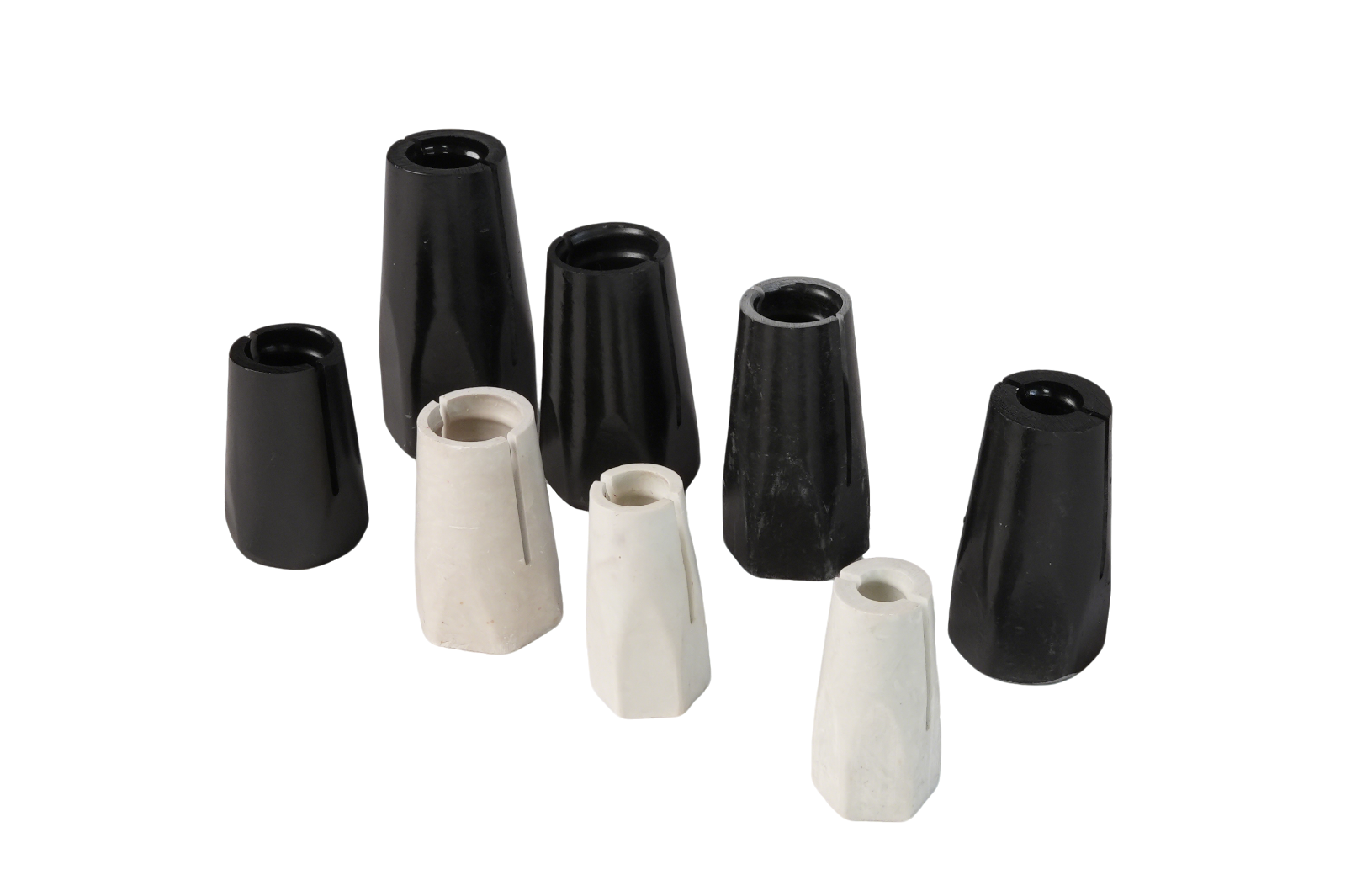
Fiberglass Nut
Product Advantages
- 1Special fasteners designed for use with FRP reinforcement
- 2High thread precision, secure fastening
- 3Corrosion resistance matches that of the reinforcement material.
- 4Ensure long-term stability of connection points
- 5Avoid electrochemical corrosion
- 6Lightweight design for easy installation
Reference Price
¥2-8/piece
*Actual price varies based on specifications and quantity.
Use Cases
I. Product Overview
1.1 Product Positioning
FRP nuts are high-performance fasteners specifically engineered to pair with FRP rock bolts, serving as critical load-bearing components in rock bolt support systems. Reinforced with high-strength fiberglass and molded from weather-resistant resin via high-temperature compression or pultrusion curing, they are seamlessly compatible with the full-thread specifications of FRP rock bolts. Widely used in coal mine roadway support, traffic slope protection, tunnel and bridge reinforcement, water conservancy slope stabilization, and building foundation strengthening, these FRP nuts represent a modern non-metallic alternative to traditional metal nuts and standard nylon nuts.
Role of 1.2 products in the support system
As a core component of the rock bolt support system, the fiberglass nut works in tandem with the fiberglass bolt rod and the fiberglass (or reinforced nylon) plate to form a complete non-metallic anchorage support system. Its specific functions include:
- Lock Anchoring Force:Thread-lock the anchor rod body to transfer anchorage force to the plate, compressing the surrounding rock surface and ensuring the anchor system achieves its designed performance.
- Load Transfer and Dispersion:Effectively transfers the tensile load from the anchor rod to the bearing plate, which then distributes the force uniformly across the surrounding rock surface, significantly increasing the reinforcement area per anchor.
- Apply Preload:Acts as the anchor point for applying preload. Tightening applies the required initial tension to the anchor rod, actively restraining surrounding rock deformation and bonding multiple soil/rock layers into a single unit, significantly enhancing the ground's self-bearing capacity.
1.3 Industry Development Background
In traditional bolt support systems, matching nuts are typically made of carbon steel or alloy steel. However, metal nuts are highly susceptible to rust and corrosion in humid underground environments and corrosive rock conditions, leading to seized threads, inability to disassemble, or loss of anchoring force. This severely compromises the long-term safety of the support system. With the increasing adoption of fiberglass bolts in mining and tunneling projects, demand for non-metallic matching nuts has grown significantly. Currently, industry-standard fiberglass bolt nuts fall into two main categories: nylon nuts and fiberglass nuts. Leveraging superior strength, durability, compatibility, and high safety factors, fiberglass nuts are gradually replacing traditional nylon and metal nuts, emerging as the preferred solution for high-end anchorage support engineering and operations under complex, harsh conditions.
2. Product Categories and Specification System
2.1 by Material
Currently, fiberglass anchor bolts are primarily paired with two types of nuts on the market. These products differ significantly in performance and are suited to different applications:
(1) Nylon Nut
Nylon nuts are injection-molded from high-strength engineering plastic (reinforced PA6/PA66). Their key advantages include low cost, lightweight design, and easy installation, making them suitable for temporary support, shallow support, and simple conditions in dry, non-corrosive environments. However, they have significant limitations: lower hardness and rigidity, limited compression and torsion resistance, and a tendency to creep under long-term load, which can lead to thread stripping or cracking. They also lack heat and aging resistance; in damp, temperature-fluctuating underground settings, they absorb moisture, age, and become brittle, failing prematurely. As a result, nylon nuts do not meet the engineering standards for permanent or high-load support. They are best suited for low-load applications with short service life and modest load-bearing requirements, such as roof bolting in roadways and temporary support systems.
(2) Fiberglass Nut (Core Featured Product)
Fiberglass nuts are high-performance fasteners engineered specifically for fiberglass anchor rods. Made from glass fiber-reinforced thermosetting resin, they are formed as a single unit via high-temperature molding or pultrusion curing. These composite accessories offer superior compressive strength, torsional strength, wear resistance, and overall load-bearing capacity compared to nylon nuts. They perfectly match all specifications of fiberglass anchor rods and form a complete composite support system when paired with fiberglass trays. For deep mining operations, high-stress zones, highly corrosive environments, or core projects requiring the highest safety standards, we strongly recommend fiberglass nuts to fully leverage the mechanical performance of the fiberglass anchor rod system.
2.2 by specification and model
Current mainstream products feature a complete specification system designed to perfectly fit the full range of fiberglass anchor bolts, including Φ16, Φ18, Φ20, Φ22, Φ25, Φ28, and Φ32. Detailed specifications are listed below:
| Applicable Anchor Bolt Diameter | Thread Load Capacity (≥ kN) | Use Cases |
|---|---|---|
| 16 | 50 | shield support, temporary support |
| 18 | 50-70 | Guard and light roof protection |
| 20 | 80 | Mainstream Selection of Roof and Rib Support for Coal Mine Roadways |
| 22 | 90-100 | Roadway support, tunnel reinforcement |
| 25 | 100-120 | Heavy-duty support for long-span tunnels and high slopes |
| 28 | 110-120 | Deep-level mines and large-scale underground projects |
| 32 | 120 | Extra-large cross-section tunnels and ultra-deep foundation pits |
Threaded connection capacity exceeds 14 kN; overall joint capacity fully covers the 50–120 kN range and meets or exceeds the yield load of the equivalent rod.
2.3 by structural design
- Hex Nut:Standard hex shape; installable with a regular wrench, pneumatic wrench, or torque wrench. Suitable for most conventional construction scenarios.
- Lock Nut:Circular design, typically used with dedicated installation tools. Ideal for projects with space constraints or specific aesthetic requirements.
2.4 Classified by Flame Retardancy and Antistatic Rating
- Standard:Meets general engineering requirements for insulation and corrosion resistance; suitable for tunnels, slopes, excavations, and other projects without special explosion-proof needs.
- Flame Retardant and Anti-StaticEngineered with a flame-retardant and antistatic compound, surface resistivity meets underground coal mine safety standards (≤3×10⁸Ω), making it suitable for high-risk environments such as high-gas mines that require stringent explosion-proof and antistatic protection.
3. Core Materials and Manufacturing Processes
3.1 Raw Material System
FRP nuts are manufactured using high-quality raw materials to ensure mechanical and durability performance meet design requirements:
- Reinforcement Material:Constructed with premium E-glass fiber yarn, with fiber content maintained between 50% and 70% to deliver exceptional tensile strength and impact resistance.
- Matrix Resin:Uses high-performance unsaturated polyester resin, vinyl ester resin, or epoxy resin as the matrix. Select the resin system based on the operating environment:
- Unsaturated Polyester Resin: Cost-effective; suitable for standard operating conditions.
- Vinyl Ester Resin: Superior corrosion resistance for harsh acidic/alkaline and high-humidity environments
- Epoxy: Best mechanical performance for ultra-high load critical engineering applications.
- Functional Fillers:Scientifically introduce wollastonite needle fibers as reinforcing fillers to effectively enhance wear resistance and creep performance.
- Additive System:Improve processability with fumed silica and enhance fiber-resin interfacial adhesion using silane coupling agents.
- Functional Additives:Add flame retardants and antistatic agents in specified proportions to ensure the product meets underground safety requirements.
3.2 Manufacturing Process
This product is manufactured using advanced prepreg molding or pultrusion processes:
- Prepreg Manufacturing:Blend glass fiber yarn with resin matrix, fillers, and additives according to a precise formulation to produce uniform prepreg. Strictly control fiber and resin content consistency across batches to ensure product quality stability.
- Molded:Weigh the prepreg precisely according to the design weight and place it into the precision mold cavity. After closing the mold, apply high temperature (typically 140°C–180°C) and high pressure (10–25 MPa) to heat, pressurize, and cure the part. During this process, the resin flows thoroughly and impregnates the reinforcement material, then undergoes cross-linking and curing reactions under high temperature to form a three-dimensional network structure.
- Pressure curing:Hold at the specified temperature and pressure for a set duration (typically 3–10 minutes, depending on product thickness) to ensure complete resin curing, resulting in a dense internal structure free of bubbles and clear, complete thread profiles.
- Demolding and Trimming:After curing, remove the product from the mold. Trim flash and burrs, then inspect with a thread gauge to ensure precise, clean threads with tight engagement and no stripping.
- Post-processing (optional):Surface finishing or secondary processing per customer requirements.
3.3 Process Advantages
Compared to simple manual processing, molding and pultrusion offer significant advantages:
- Uniform product density:Molded under high temperature and high pressure; free of bubbles, cracks, or delamination defects.
- High dimensional accuracy:Precision-machined molds ensure accurate thread profiles, with the clearance between the bolt body threads controlled within an optimal range.
- Consistent batch quality:Process parameters are fully controllable, ensuring minimal batch-to-batch performance variation and quality stability that far exceeds industry standards.
- High production efficiency:Short molding cycle; ideal for high-volume continuous production.
IV. Core Performance Advantages
4.1 High load-bearing capacity with strong support stability
The fiberglass nut features a glass fiber-reinforced structure, delivering exceptional compressive strength, torsional resistance, and pull-out performance. Each thread can support over 14 kN, while overall connection capacities across various sizes range from 50 kN to 120 kN—exceeding the yield load of the rod body. This ensures that under extreme loads, failure occurs in the rod rather than the nut, eliminating the common issue of "nut stripping before rod failure" seen in traditional assemblies. The result is uniform stress distribution and superior system stability. Fully compliant with national and industry standards for support loads, the product effectively disperses rock pressure, prevents block slippage and deformation, and guarantees long-term stability for roadways, slopes, and excavations. Ideal for high-load, large-span support applications.
4.2 Super corrosion resistance, exceptionally long lifespan
Metal nuts corrode rapidly in damp, acidic, or alkaline environments. Rust-induced swelling and deformation can compromise support structures, while long-term use often leads to seized threads that are difficult to remove, making maintenance extremely challenging. Nylon nuts, conversely, absorb moisture over time in humid underground conditions, leading to aging, brittleness, and eventual failure. In contrast, fiberglass-reinforced plastic (FRP) nuts are inert composite materials that do not rust or oxidize. They offer exceptional resistance to acids, alkalis, moisture, mine water, and chloride ion attack. Even under harsh operating conditions—such as high-humidity coal mine environments, coastal areas with heavy salt fog, or chemical corrosion sites—they remain free from corrosion-related failures. Designed for a service life of over 50 years, FRP nuts far exceed the durability of traditional metal and nylon components, enabling permanent structural support and significantly reducing long-term maintenance and replacement costs.
4.3 Safety explosion-proof, designed for special underground scenarios
The fiberglass nut is engineered with a flame-retardant and anti-static compound, ensuring its surface resistivity meets underground coal mine safety standards (≤3×10⁸ Ω). Made from non-conductive, non-magnetic material, it eliminates the risks associated with metal nuts, such as electrical conduction and magnetic interference. In longwall mining operations, the nut can be cut along with the anchor bolt without damaging cutting picks or generating sparks, effectively preventing gas explosions and significantly improving mining efficiency. Ideal for underground blasting, electrified tunnels, and electromagnetic-sensitive projects, it produces no sparks or electromagnetic interference, making it the standard safety component for high-risk support applications in coal mines, metal mines, and other industrial environments.
4.4 Insulated and non-magnetic; ideal for specialized applications
The fiberglass nut is a fully non-metallic, electrically insulating component with high resistivity (volume resistivity ≥ 1 × 10¹² Ω). It does not conduct electricity or heat and offers excellent wave transmission. In engineering scenarios requiring special electromagnetic protection, it generates no electromagnetic eddy current interference. When used in electrified railway tunnels, subway sections, and communication tunnels, it does not interfere with the operation of detection instruments such as ground-penetrating radar and electromagnetic detectors. It offers unique advantages in projects with stringent electromagnetic shielding requirements, such as those near nuclear power plants and military bunkers.
4.5 Lightweight design for fast, efficient installation
FRP nuts have a density of only 1.8–2.1 g/cm³ and weigh just 1/4 to 1/5 of equivalent steel anchor rod nuts. This significantly reduces workers' physical effort during on-site handling and installation, enabling rapid preload operations without heavy tools and boosting individual efficiency by over 30%. These advantages are especially pronounced in complex environments such as confined underground spaces and high-altitude slopes. Additionally, the lightweight design lowers the overall load on support structures, preventing secondary compression of rock masses from additional stress.
4.6 material offers high compatibility and strong system support
Fiberglass nuts are part of the same composite system as fiberglass anchor bolts and fiberglass trays, sharing highly matched coefficients of thermal expansion, elastic modulus, and mechanical properties. This is demonstrated in the following aspects:
- Coefficient of thermal expansion match:The coefficient of thermal expansion for fiberglass-reinforced plastic (approximately 8-12×10⁻⁶/°C) is closer to that of concrete and geotechnical materials (approximately 8-12×10⁻⁶/°C) than steel (approximately 11-13×10⁻⁶/°C). This allows the material to better accommodate creep and thermal deformation in geological layers, reducing prestress loss caused by temperature fluctuations or ground settlement.
- Stiffness Matching:The elastic modulus of the same material system is similar, ensuring uniform stress distribution under load. This avoids stress concentration and localized thread damage that can occur when metal nuts are paired with composite anchors due to stiffness differences.
- Electrochemical Compatibility:Since both materials are non-metallic, there is no risk of galvanic corrosion.
The integrated composite support system ensures uniform load distribution, high conformity, and strong bonding stability. It effectively enhances overall anchorage performance and eliminates support failures caused by poor compatibility among different material components.
5. Material Comparison and Selection Analysis
5.1 Fiberglass Nut vs. Traditional Steel Anchor Nut
| Comparison Criteria | Fiberglass Nut | Steel Anchor Nut |
|---|---|---|
| Material | Fiber-reinforced polymer composite | Carbon Steel / Alloy Steel |
| Density (g/cm³) | 1.8-2.1 | 7.8 |
| Weight Ratio | 1/4-1/5 | 1 |
| Corrosion Resistance | Excellent (acid, alkali, salt, and moisture resistant) | Poor (prone to rust) |
| Insulation | Excellent (Fully Insulated) | None (conductive) |
| Magnetic | Yes | |
| Flame Retardant and Antistatic | Customizable | Sparks may occur upon impact. |
| Long-term Stability | Non-creeping, anti-aging | Susceptible to rust and seizing |
| Maintenance Cost | Low (Maintenance-Free) | High (requires regular replacement) |
Conclusion:In conventional geotechnical projects without special explosion-proof requirements, steel nuts are still used. However, in coal mine underground environments, damp conditions, or projects requiring insulation or explosion-proofing, fiberglass nuts offer irreplaceable advantages.
5.2 Fiberglass Nut vs. Nylon Nut
| Comparison Criteria | Fiberglass Nut | nylon nut |
|---|---|---|
| Material | Fiberglass-reinforced thermosetting resin | Reinforced Nylon PA6/PA66 |
| Compressive Strength | High (≥200MPa) | Medium (approx. 80-120 MPa) |
| Torsional Performance | Excellent, Resists Deformation | Average; threads strip easily |
| Creep resistance | Excellent (non-creeping) | Poor (prone to deformation under long-term load) |
| Heat resistance | Good (up to 120°C or higher) | Moderate (≤80°C) |
| Aging resistance | Excellent | Moderate (prone to moisture-induced aging) |
| Flame Retardant and Antistatic | Consistently meets targets | Partially met, unstable |
| Long-term Stability | Excellent | Poor (prone to preload relaxation) |
| Cost | Medium | Lower |
| Recommended Scenarios | Permanent support, heavy-duty, high-corrosion resistance, and stringent safety requirements | Temporary support, low-load, cost-sensitive projects |
Conclusion:For core engineering applications with stringent support safety requirements—such as permanent mine roadways, deep-level mining, high-stress zones, and highly corrosive environments—fiberglass nuts are the superior choice. Nylon nuts are suitable only for low-load, short-term scenarios like face protection and temporary support.
5.3 Selection Recommendation
| Engineering Scenario | Recommended Products | Selection Criteria |
|---|---|---|
| Coal mine face/roadway roof support | FRP Nut (Flame Retardant & Anti-Static) | High-load, high-safety requirements; capable of cutting with the shearer |
| Coal mine roadway support | Nylon nut or fiberglass nut | Light payload; select based on budget. |
| High-gas mine | FRP Nut (Flame Retardant & Anti-Static) | Strict explosion-proof safety requirements |
| Initial support of tunnels | Fiberglass Nut | Permanent support with high load requirements |
| Temporary slope reinforcement | nylon nut | Short-term use, cost-first |
| Coastal/Corrosive Geological Conditions | Fiberglass Nut (Vinyl Ester Resin Type) | High salt spray corrosion resistance required |
| Electrified Railway Tunnel | Fiberglass Nut | Insulation Requirements |
| Hydraulic Engineering / Damp Environments | Fiberglass Nut | Long-term water and corrosion resistance |
VI. Application Areas
6.1 Mine roadway support
This product is compatible with full-thread or twisted fiberglass resin anchor bolts and is widely used for underground roadway support in coal mines, metal mines, and non-metallic mines.
- Retrievable roadway:Two-way roadway advanced support can be directly cut by the shearer without prior dismantling.
- Drift roadway:Head and rib support for safe tunneling operations
- Large Cross-Section Chambers:Support of surrounding rock in high-stress zones
6.2 Tunnels and Underground Engineering
- Initial support and systematic rock bolts for railway and highway tunnels
- Subway Tunnel Sections and Underground Stations Built by Mining Method
- Hydraulic tunnels and water conveyance tunnels
- Ground reinforcement of underground powerhouse and cavern complexes
6.3 Slope and Foundation Pit Engineering
- Protection and reinforcement of steep slopes along highways and railways
- Landslide remediation
- Urban Deep Excavation Support
- Civil Air Defense Engineering
6.4 Water Conservancy and Ocean Engineering
- Reservoir Dam Reinforcement
- Port and Terminal Slope Protection
- Geotechnical Support for Coastal High-Salinity Corrosive Environments
- Offshore wind turbine foundation slope reinforcement
6.5 Other Special Projects
- Electrified Railway Tunnel (Insulation Requirements)
- Reinforcement of rock mass surrounding nuclear power plants (with electromagnetic shielding requirements)
- Military Bunkers and Protective Engineering
- Slope Stabilization for Contaminated Sites in Chemical Industrial Parks (Strong Corrosion Environment)
- Strengthening of Building Foundation Concrete Structures and Rebar Anchoring
VII. Technical Specifications Overview
| Parameter Item | Technical Specifications |
|---|---|
| Material | Fiberglass-reinforced unsaturated polyester/vinyl/epoxy resin |
| Density | 1.8-2.1 g/cm³ |
| Fiberglass content | 50%-70% |
| Applicable Anchor Rod Diameter | Φ16, Φ18, Φ20, Φ22, Φ25, Φ28, Φ3 2mm (customizable) |
| Nut shape | Hex Nuts / Round Nuts (as per customer requirements) |
| Thread Load Capacity (≥) | 14kN/coupling |
| Overall connection bearing capacity | 50-120 kN (as specified) |
| Tensile Strength (≥) | 200 MPa |
| Shear Strength (≥) | 80 MPa |
| Volume Resistivity (≥) | 1×10¹² Ω |
| Surface Resistance (≤) | 3×10⁸Ω (Flame-Retardant & Antistatic) |
| Flame Retardant Rating | V-0 Level (Optional) |
| Coefficient of Thermal Expansion | 8-12×10⁻⁶/℃ |
| Operating Temperature Range | -10°C ~ 120°C (depending on resin system) |
| Product Execution Standard | MT/T 1061-2008 and related industry standards |
8. Installation and User Guide
Pre-installation check for 8.1
- Inspect nut thread integrity; confirm absence of cracks, missing threads, broken threads, burrs, or other defects.
- Verify that the nut thread specification fully matches the anchor bar body thread; ensure smooth rotation without binding.
- Check that the matching tray is intact and matches the specifications.
8.2 Installation Steps
- Step 1: Install Anchor Bolts
Install the fiberglass anchor rod and mix the resin cartridge according to design specifications. Allow the resin to fully cure and reach the specified strength.
- Step 2: Tray Installation
Place the tray (FRP or reinforced nylon) firmly against the surrounding rock surface, ensuring the center hole aligns with the anchor rod. The tray must be flush against the rock face with no gaps or tilting.
- Step 3: Install Nut
Manually thread the fiberglass nut onto the threaded end of the anchor rod until it contacts the plate. The manual insertion should be smooth without any binding. If resistance is encountered, check for thread mismatch or damage.
- Step 4: Apply preload
Apply the design preload torque to the nut using a pneumatic impact wrench or a torque wrench. The preload torque must be strictly controlled within the design range: insufficient torque fails to effectively restrain surrounding rock deformation, while excessive torque may cause thread overload damage to the nut or yield failure of the anchor rod body. Reference values for common preload torque: For Φ20 anchor rods with matching nuts, the recommended torque is 80-120 N·m; however, always refer to the engineering design documents for specific requirements.
- Step 5: Quality Check
After installation, verify that the nuts are tightly seated against the tray with no looseness. If necessary, perform spot checks using a torque wrench to confirm that preload requirements are met.
8.3 Installation Notes
- Do not apply lubricants or any substances that may reduce the coefficient of friction to the nut threads, as this could cause loosening under dynamic loads.
- Avoid using impact tools with excessive torque to prevent thread damage or sudden overload failure.
- For projects requiring flame retardancy and antistatic properties, do not use tools or auxiliary materials that may contaminate or damage the product surface during installation.
- If a nut shows cracks, damage, or thread defects during installation, replace it immediately. Do not force its use.
- In coal mining faces, fiberglass nuts can be cut directly with the anchor bolts without requiring dedicated removal prior to extraction.
8.4 Storage and Handling Requirements
Storage Conditions:
- Store in a cool, dry, and well-ventilated warehouse.
- Avoid prolonged exposure to sunlight and rain outdoors to prevent UV-induced aging of the resin matrix.
- Recommended storage temperature range: -10°C to 40°C
- Keep away from open flames, heat sources, and strong corrosive chemicals.
- Avoid stacking heavy items on top during storage to prevent long-term deformation.
Shipping Requirements:
- Protect during transit; avoid direct impact on threaded areas from heavy objects to prevent deformation and ensure installation accuracy.
- Packaged in cartons or woven bags with internal cushioning protection.
- Handle with care during loading and unloading; do not throw.
- Protect from rain and sun during transit; do not transport with corrosive substances.
8.5 Safety Precautions
- Although FRP nuts are made of flame-retardant and anti-static materials, prolonged exposure to open flames or extreme heat sources should still be avoided.
- Dispose of discarded fiberglass nuts in accordance with industrial solid waste regulations, using landfill or incineration methods. Do not discard them indiscriminately.
- Dust may be generated during product cutting or grinding. Operators must wear protective masks and safety goggles.
9. Custom Services
Anhui Send New Material Technology Development Co., Ltd. provides comprehensive customized services tailored to meet diverse customer operating conditions:
9.1 Custom Non-Standard Sizes
Custom non-standard fiberglass nuts tailored to special thread specifications (e.g., metric, trapezoidal, or custom profiles) and unique structural requirements, ensuring precise alignment with your specific engineering needs.
9.2 Material Formula Customization
Select from different resin systems based on specific environmental requirements:
- Unsaturated Polyester System:Standard cost-effective solution for general operating conditions
- Vinyl Ester System:Corrosion-resistant formula designed for severe acidic and alkaline environments
- Epoxy system:Ultra-high-strength formula for critical engineering under extreme loads
9.3 Custom Flame-Retardant & Anti-Static Rating
Customizable flame retardancy levels and surface resistance specifications to meet safety standards across diverse mining operations, from general engineering projects to high gas-content mines.
9.4 integrated supply
One-stop supply of complete composite support kits including fiberglass anchor rods, nuts, and trays. Comprehensive specifications and models available to perfectly match all standard and custom support engineering requirements. 100% compatibility with products from the same source eliminates issues caused by mismatched components from different manufacturers, ensuring optimal support performance.
10. Quality Assurance and Service System
10.1 Quality Control System
Anhui Sende New Material Technology Development Co., Ltd. operates standardized production workshops and is equipped with a full suite of automated compression molding and pultrusion machinery, backed by a comprehensive quality control system.
- All products strictly adhere to scientific material formulations, utilizing premium alkali-free glass fiber and high-temperature resistant, corrosion-resistant resins.
- Every batch undergoes sampling tests for compressive strength, torsional strength, thread load capacity, and corrosion resistance.
- One-piece molded, uniform density, bubble-free, crack-free, and precisely threaded.
- Strictly adheres to industry standards such as MT/T 1061-2008, ensuring no defective products leave the factory. Product stability and consistency far exceed industry averages.
10.2 Pre-sales Technical Support
Our dedicated technical team provides comprehensive pre-sales services, including product selection, application-specific solutions, and technical parameter consulting. We help you identify the optimal product solution to prevent safety risks and cost overruns caused by incorrect selection.
10.3 After-Sales Guarantee
Ample production capacity and stable inventory enable us to fulfill large-volume orders, ensuring on-time delivery without project delays. Our rapid after-sales response is backed by a dedicated team that supports your project from start to finish, promptly resolving any procurement or usage issues—so you can purchase with confidence and use with peace of mind.
Summary
The FRP anchor bar's dedicated FRP nut has become an essential component in modern geotechnical anchoring projects due to its high load-bearing capacity, superior corrosion resistance, excellent explosion-proof safety, outstanding electrical insulation and non-magnetic properties, lightweight design for easy installation, and perfect material compatibility with the anchor bar. Compared to traditional nylon and metal nuts, the FRP nut offers significant advantages in safety, durability, stability, and system compatibility. It is the optimal choice for permanent support and high-safety engineering applications across coal mine roadways, tunnel surrounding rock, slope protection, water conservancy projects, and other geotechnical anchoring scenarios.
Anhui Send New Material Technology Development Co., Ltd.
Specializing in the R&D and production of complete composite support accessories, including fiberglass anchors, nuts, and trays.
Delivering high-quality, highly adaptable, and fully customizable non-metallic anchoring and support solutions.
Ensuring long-term support for engineering safety