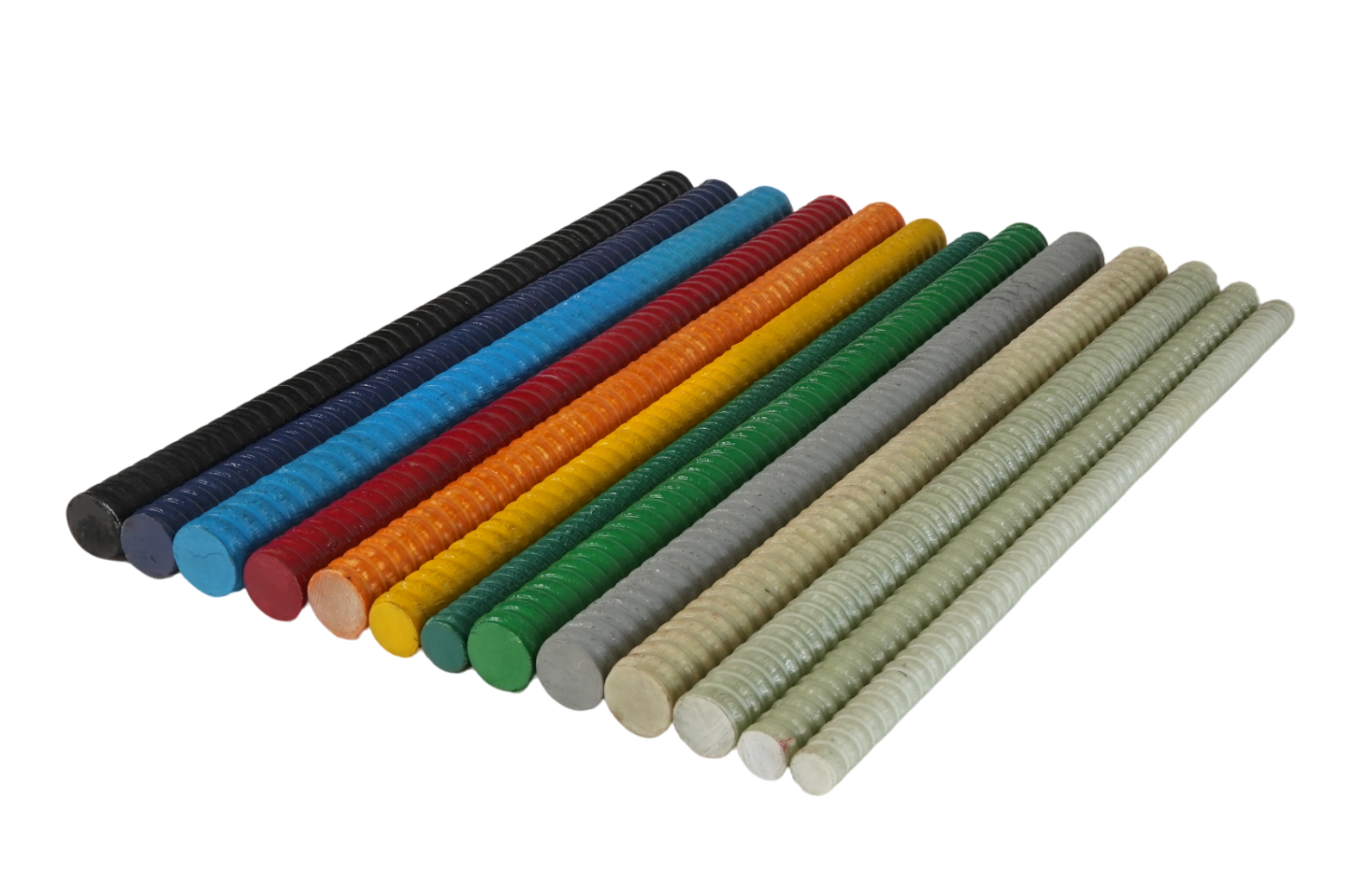
Fiberglass Rebar (GFRP Bar)
Product Advantages
- 1Superior Corrosion Resistance: Offers more than 10 times the corrosion resistance of ordinary steel. With virtually no corrosion in acidic, alkaline, or saline environments, it is ideal for harsh conditions such as marine engineering, chemical plants, and wastewater treatment facilities.
- 2Superior mechanical performance: tensile strength up to 600-1000 MPa, elastic modulus ≥40 GPa. Fully meets structural requirements for all types of construction projects and far exceeds traditional rebar standards.
- 3Lightweight design: Only 1/4 the weight of steel, significantly reducing transportation and construction costs. Easy to carry and install by one person, improving construction efficiency by over 30%.
- 4Ultra-Long Service Life: Validated by accelerated aging tests, the product maintains over 95% strength after 5000 hours of immersion in simulated seawater, with a design lifespan of 50-100 years.
- 5Non-magnetic: Ideal for environments sensitive to electromagnetic interference, such as MRI rooms in hospitals, research laboratories, and power facilities.
- 6Low Maintenance Costs: No anti-corrosion treatment required, significantly reducing lifecycle maintenance costs and boosting overall economic benefits by more than 40%.
Reference Price
¥2-35 per meter
*Actual price varies based on specifications and quantity.
Use Cases
Comprehensive Technical and Application Guide for Glass Fiber Reinforced Polymer (GFRP) Rebar
1. What is a fiberglass rebar?
Fiber-reinforced polymer (FRP) rebar, commonly known as glass fiber rebar or composite rebar, is a type of FRP reinforcement made by pultruding continuous glass fibers in a synthetic resin matrix and curing the resulting composite material.
Designed to replace traditional steel reinforcement in specific environments, it fundamentally addresses structural durability issues caused by electrochemical corrosion of steel. First deployed in engineering applications in 1975, it has since become the most widely used non-metallic reinforcing material in civil engineering.
II. Raw Material Composition and Production Process
1. Core Ingredients
| Components | Share | Function |
|---|---|---|
| High-Strength Glass Fiber Yarn | ≥70% | Carries the entire tensile load, determines the tensile strength of the reinforcement, and is the core source of mechanical performance. |
| synthetic resin matrix | Rest of the content | Encapsulates fibers, transfers shear forces, and isolates them from external acids, alkalis, moisture, and water vapor to protect against corrosion. |
| Functional additives | Small quantity | Antioxidants, release agents, color masterbatches, etc., to enhance weatherability and processing convenience. |
Key distinction: Fiber type determines the upper limit of alkali resistance, while resin system dictates overall durability.
2. Mainstream Production Processes
The industry widely adopts the continuous pultrusion process, which follows these steps:
Unwind fiberglass roving → Impregnate with resin → Mold shaping → High-temperature curing → Surface rib machining → Cut to length → Final inspection
Seamless one-piece molding with no welded joints ensures uniform and stable mechanical performance. The surface can be machined with threaded or continuous ribs to enhance bonding with concrete.
3. Core Performance Parameters (vs. Traditional Rebar)
| Performance Metrics | GFRP bars | Ordinary Steel Bars (HRB400) | Comparison Conclusion |
|---|---|---|---|
| Density | 1.9–2.1 g/cm³ | 7.85 g/cm³ | GFRP weighs only 1/4 to 1/6 of steel, making it lightweight and easy to handle. |
| Tensile Strength | 400~1000 MPa | 400 MPa | GFRP is typically 2 times stronger than steel reinforcement. |
| Elastic Modulus | 40~55 GPa | 200 GPa | GFRP has only 1/4~1/5 the stiffness of steel; low stiffness is its major drawback. |
| Corrosion Resistance | Resistant to acids, alkalis, and salt spray; strength retention rate > 90% | Severe corrosion within 5 years in high-humidity, saline-alkali environments | GFRP wins by a landslide |
| Electromagnetic Properties | Fully non-magnetic and non-conductive | Magnetic and conductive | GFRP tailored for specialized electromagnetic environments |
| Coefficient of Thermal Expansion | Close to cement | Close to cement | GFRP experiences lower internal thermal stress. |
| Lifespan (harsh conditions) | 50 years of maintenance-free operation | 15–20 | GFRP has a lower total lifecycle cost. |
4. Product Categories
Categorized into three types based on the resin matrix:
| Type | Alkali resistance | Mechanical Properties | Cost | Use Cases |
|---|---|---|---|---|
| Unsaturated Polyester Rebar | Poor | Average | Lowest | General civil engineering, temporary support |
| Vinyl Ester Resin Rebar | Excellent | Good | Medium | Chemical anti-corrosion, marine engineering, municipal engineering |
| Epoxy-coated rebar | Good | Best | Higher | Prestressed structures and high-strength, high-durability key projects |
V. Core Advantages (Itemized Breakdown)
| Advantages | Specific Details |
|---|---|
| Ultimate Corrosion Resistance | Resists chloride ions in seawater, soil pH extremes, and industrial chemical fumes to prevent concrete cracking and spalling caused by corrosion at the source—eliminating the need for future anti-corrosion repairs. |
| Lightweight and High-Strength | Weighs only 1/4 of steel rebar. Can be manually lifted and tied without heavy cranes, making it ideal for confined spaces such as tight work areas, tunnels, and underground shafts. |
| Magnetic Insulation | Non-magnetic and non-conductive; ideal for precision electromagnetic equipment environments such as hospital CT rooms, subway signal base stations, and radar facilities. |
| Easy to cut | Low shear strength allows direct cutting by shield machines or on-site cutting with abrasive saws. No hot work welding is required, eliminating fire hazards from open flames. |
| Excellent thermal synergy | Close coefficient of thermal expansion to cement, minimal thermal deformation, and superior freeze-thaw resistance compared to reinforced concrete. |
VI. Performance Limitations (Must Be Addressed)
| Limitations | Impact | Response Strategy |
|---|---|---|
| Brittle material, no yield point | Minimal plastic deformation before fracture; brittle failure. Safety margin requires reassessment. | Enhance safety factors and strictly control crack widths |
| Low modulus of elasticity (only 1/4 of steel) | Under the same load, deformation is approximately 4 times that of steel reinforcement, resulting in greater deflection and wider cracks. | Increase the reinforcement ratio and recalculate based on stiffness. |
| Low shear strength | The typical failure mode of components is pull-out rather than tensile rupture. | Special bond verification; enhance mechanical interlocking construction |
| Long-term creep | Under sustained loading, deformation increases over time, leading to prestress losses of 30%~50%. | Apply creep reduction factor (0.5~0.7) |
| Limited heat resistance | The glass transition temperature (Tg) is typically 120~200°C; exceeding this range causes a sharp decline in performance. | Additional fire protection required for fire scenarios |
| Major weakness: Alkali resistance | Ordinary E-glass continuously degrades in concrete with a pH of 12~13, losing 20%~40% of its strength over 5~8 years. | AR-glass + vinyl ester/epoxy resin is required. |
7. Engineer's Perspective: Top 8 Core Focus Areas (Ranked by Importance)
1. Mechanical Properties – Adequate Strength, Insufficient Stiffness
Tensile strength exceeds that of steel, but the elastic modulus is only 40~55 GPa (steel: 200 GPa). Under identical loads, deflection is approximately 4 times greater than steel; controlling crack width is critical in design. GFRP bars are best suited for applications where deformation is less critical but corrosion resistance is paramount (e.g., subsea tunnels, sewage tanks, bridge piers), and should not be used directly in beams or slabs requiring high stiffness.
2. Alkali Resistance – The Most Critical Weakness
GFRP resists corrosion but is vulnerable to alkali. The highly alkaline environment of concrete (pH 12–13) continuously attacks standard E-glass fibers, causing irreversible strength loss.
3 questions every purchaser must ask:
| Key Issues | Recommended Answer |
|---|---|
| What fiber is used? | AR-glass (alkali-resistant glass fiber) must be used; its alkali resistance is an order of magnitude higher than that of E-glass. |
| What is a resin system? | Prioritize vinyl ester resin (alkali resistance: vinyl ester > epoxy > polyester) |
| Is there accelerated aging data? | Strength retention rate ≥ 75% after soaking for 1000 hours at 80℃ and pH=13. |
3. Bond Performance — Pull-out failure is more common than tensile failure.
GFRP rebars exhibit weaker chemical adhesion to concrete than steel rebars, leading to a predominant "pull-out" failure mode. Design cannot rely solely on tensile strength; specialized bond verification or significantly increased safety factors are required.
4. Long-term Creep – The Silent Killer of Prestress
Viscoelastic materials continue to deform under sustained loads, potentially reducing the effective prestress after tensioning to only 50%–70%. Creep reduction factors must be applied to prestressed members.
5. Temperature Resistance — Performance Drops Abruptly Above Tg
Standard GFRP bars have a Tg of 120~200°C and may lose most of their load-bearing capacity within minutes if exposed to temperatures above 200°C in a fire. Buildings with fire safety requirements need additional fire protection.
6. Design Basis — Standards exist, but are immature
Primary domestic references: GB 50608 "Technical Specification for Application of Fiber-Reinforced Composite Materials in Construction Engineering" and JG/T 406-2013. However, compared to the mature GB 50010 system for steel reinforcement, GFRP design methods are still being refined. Many parameters must reference ACI 440.1R or CSA S806. Drawing review experts may be unfamiliar with this system, potentially causing delays in calculation document approval.
7. Construction Adaptation – Welding is not possible; connection presents a challenge.
- No open flames or welding allowed. Minimum bending radius: 8 to 10 times the bar diameter.
- Connection methods: mechanical (sleeve/threaded couplers), lap, and adhesive bonding—all are more complex than rebar tying.
- Only trained personnel should perform bending operations; improper handling can cause internal fiber breakage.
8. Electrochemical corrosion – isolate when in contact with metal
GFRP bars are non-conductive; however, direct contact with metal components such as steel plates or aluminum parts in humid environments can cause galvanic corrosion, accelerating the degradation of the metals. Proper insulation isolation is required during design.
Engineer's one-sentence summary: GFRP resists corrosion but is vulnerable to alkali, heat, creep, and lacks standards.
8. Buyer's Perspective: 7 Key Procurement Points
| Focus Areas | Core Requirements |
|---|---|
| Cost-effectiveness | Don't focus on unit price; consider the full life-cycle cost (LCC). In highly corrosive environments, GFRP may offer a lower total cost. |
| Quality Consistency | Coefficient of Variation (COV) for tensile strength must be ≤5%. Third-party test report required. |
| Supplier Capacity | Confirm whether the production line operates 24 hours/day and can handle concentrated supply. |
| Certifications | CRCC Railway Product Certification (a near-mandatory requirement for infrastructure projects), ISO System Certification, and Type Test Reports |
| Use Cases | Real-world feedback from similar projects: How long have they been in use, and are there any issues? |
| Technical Support | Can the supplier send technical staff onsite to guide bending, connection, and tensioning? This is essential. |
| Delivery & Logistics | Cable reels are susceptible to crushing, impact, and sun exposure. The contract shall clearly specify packaging requirements and acceptance inspection standards upon delivery. |
Buyers' one-sentence summary: Price isn't the issue; instability and lack of support after problems arise are.
9. Application Scenarios
| Scenario | Typical Applications | Core Requirements |
|---|---|---|
| Marine and Coastal Engineering | Pile foundations for wharves, seawall slopes, and cross-sea bridge decks | Resist chloride corrosion from seawater |
| Underground Tracks and Tunnels | Reinforcement at subway shield tunnel entrance, initial support, and cuttable reinforcement for shield machines | Prevent stray current corrosion and protect the shield cutterhead |
| Non-magnetic Specialized Construction | Hospital CT Room, Radar Station, Electromagnetic Shielding Laboratory | Eliminate magnetic interference |
| Roads & Municipal | Strengthening of pavement, bridge deck surfacing, and expansion joints in salt-frost regions | Mitigate deicing salt corrosion |
| Chemical & Mining | Chemical plant flooring, pickling tanks, and underground coal mine support systems | Acid- and alkali-resistant; moisture-proof |
| Water Conservancy Project | River embankment protection, sluice gate base slabs, and reservoir seepage prevention. | Rust-proof for long-term underwater use |
Note: High-voltage load-bearing components in conventional civilian buildings, such as main beams and columns, rarely use GFRP bars. This material is specifically designed for specialized engineering projects where traditional steel reinforcement has significant limitations.
10. Construction Precautions
| Task | Requirements |
|---|---|
| Construction Method | Can be tied or lapped directly without changing concrete pouring processes. |
| No open flames | Cutting must be performed with cold cutting equipment (abrasive saws) to prevent heat damage to the resin matrix. |
| reinforcement ratio | Due to low modulus of elasticity, increase reinforcement ratio appropriately to control member deflection. |
| Store | Avoid prolonged exposure to direct sunlight. If stored outdoors, cover with a waterproof and UV-resistant tarp. |
| Connect | Bend radius ≥ 8–10 × bar diameter. Prefer mechanical splicing to avoid stress concentration. |
11. Relevant Standards
| Standard Number | Name | Description |
|---|---|---|
| JG/T 406-2013 | Fiber-Reinforced Polymer Bars for Civil Engineering Applications | Product Technical Requirements and Test Methods |
| GB 50608 | Technical Specification for Application of Fiber-Reinforced Composite Materials in Construction Projects | Primary basis for design and application |
| ACI 440.1R | ACI Design Guide for GFRP | Commonly referenced in domestic design |
| CSA S806 | Canadian GFRP Design Standard | Another important international reference |
| CRCC Certification | Railway Product Certification | Mandatory Thresholds for Railway and Highway Projects |
12. Industry Outlook
As domestic infrastructure shifts toward durability and sustainability, the scale of coastal, underground, and specialized medical facilities continues to expand. Traditional steel rebar corrosion poses growing safety risks and high maintenance costs. GFRP bars offer low carbon footprint, long-term durability, and zero maintenance, aligning perfectly with national dual-carbon goals. With evolving design codes and declining production costs, GFRP bars are poised to replace traditional steel in corrosion-resistant structures, non-magnetic applications, and cuttable underground support systems.
13. Why Choose Anhui Senda
Choose Anhui Sende New Material Technology Development Co., Ltd. for fiberglass rebar—a smart choice backed by expertise, product strength, and market reputation.
1. Focused Expertise, Proven Strength
Anhui Send New Materials is a technology-driven enterprise specializing in the R&D, manufacturing, and sales of fiber-reinforced composite materials. Established in 2017, with registered capital of 2000 ten-thousand yuan, the company is located in Quanjiao County Economic Development Zone, Chuzhou City, Anhui Province. Committed to technological innovation, we hold multiple patents, including "Auxiliary Conveying Device for Fiberglass Rebar Production," which has been registered with the Anhui Provincial Department of Science and Technology and recognized as a high-tech enterprise. We also actively collaborate with leading universities such as Jilin University on applied research projects to drive continuous technological advancement.
II. Superior Product, Reliable Performance
Sunde fiberglass rebar offers outstanding advantages including lightweight construction, high strength, corrosion resistance, rust-free performance, and ease of cutting. Its tensile strength reaches ≥550MPa or even ≥600MPa, far exceeding that of ordinary steel rebar. Product diameters range from 8mm to 36mm, with lengths customizable to meet specific requirements. The company also provides a series of products such as fiberglass water-stop bolts and fiberglass rock bolts to address diverse engineering needs.
3. Flexible Customization, Comprehensive Service
As a manufacturer, Anhui Send New Materials supports product customization and offers factory-direct supply with worry-free after-sales service. Our platform commitments include genuine product guarantees, authentic materials, 24/72-hour dispatch, and 7-day replacement, ensuring a seamless procurement experience.
IV. Outstanding Performance, Market Recognition
Our products have been successfully deployed in national key projects, including the new Nantong-Ningbo High-Speed Railway and Yanyi Railway by China Railway 14th Bureau, as well as the TJ7 section of Qinghua Expressway. Additionally, we have secured procurement orders from major industrial clients such as Shaanxi Yulin Energy Group for mining support materials. Our product quality and service standards have been rigorously validated by the market.
Choose Anhui Sende New Materials for professional quality, reliable performance, and worry-free service.